
Comparison · 5 min read
Casio vs Seiko: Which Watch Brand Suits You?
Casio and Seiko get compared constantly, and the comparison is usually framed as a contest. It is a poor contest, because the two companies are different kinds of company…
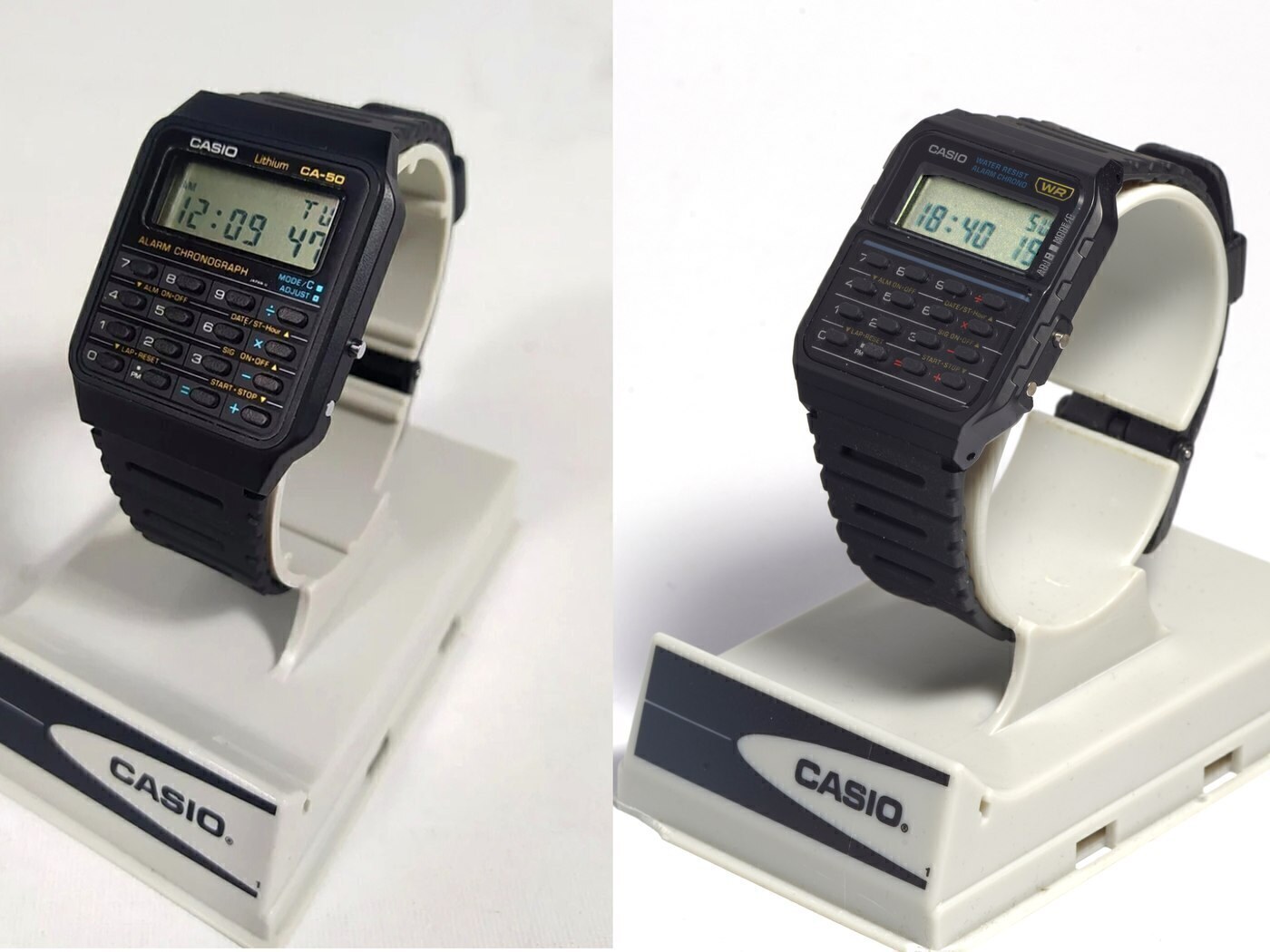
Casio and Seiko get compared constantly, and the comparison is usually framed as a contest. It is a poor contest, because the two companies are different kinds of company that happen to both make watches in Japan. Seiko is a watchmaker that grew into precision instruments. Casio is an electronics company that made watches because it turned out small calculators and small watches need the same things.
That difference, more than any specification, is what decides which one suits you.
The short version
| Casio | Seiko | |
|---|---|---|
| Founded | 1946, as a calculator maker | 1881, as a watch and clock business |
| First watch | Casiotron, 1974 | From the 1880s; early wristwatches in the 1910s |
| What it is | An electronics company with a large watch business | A watchmaker with a precision-instruments history |
| Range bottom | Very inexpensive digital watches | Inexpensive quartz watches |
| Range top | High-specification digital and some mechanical lines | Serious mechanical watchmaking, including hand-finished pieces |
| Best known for | Tough, affordable, feature-dense digital watches | Mechanical movements, and a decisive role in quartz |
| Calculator watch heritage | The C-80 in 1980, and the CA and Databank lines since | Technical calculator models in the late 1970s and 1980s |
| Servicing | Often replacement-oriented | Serviceable mechanical movements, with parts networks |
Both are Japanese, both are independent, and neither owns the other. Beyond that, the table is a table of two different answers to the same question.
Two different origins
Seiko started with watches
Seiko's history begins in 1881 as a watch and clock business, and by the middle of the twentieth century it was making its own movements, its own hairsprings and its own cases. That vertical depth is why it could enter observatory competitions, build the mechanical chronographs that became collectible, and ultimately produce the Astron 35SQ on 25 December 1969 — the first quartz wristwatch sold to the public.
The quartz revolution is the pivot that explains modern Seiko. The company that had spent decades perfecting mechanical watchmaking was also the company that made it obsolete, and it then spent the following decades doing both: mass-market quartz at the bottom and increasingly serious mechanical watchmaking at the top. Its later innovations — Spring Drive, which regulates a mechanical movement electronically — come from being fluent in both.
Casio started with calculators
Casio's founding object is the calculator, not the clock. When it entered watchmaking in 1974 with the Casiotron, it did so by treating a watch as a device that calculates time. That is why an early Casio could correct its own calendar while better watchmakers were still printing date wheels that needed adjusting five times a year.
Everything Casio is known for follows from that premise: the C-80 calculator watch in 1980, the Databank line in 1984, G-Shock in 1983. Each is a small electronic instrument that happens to be worn, and each was designed around function and cost rather than around finishing.
Movements
Seiko designs and builds its own movements across the whole range, mechanical and quartz, and its mechanical calibres are the reason the brand matters to enthusiasts. That means serviceable, documented, repairable mechanisms — and a depth of catalogue from basic automatics to high-beat and hand-finished work.
Casio builds quartz modules, and its engineering strength is in packing functions into them: sensors, solar charging, radio timekeeping, world time, calculators. Its mechanical offerings are a small part of its business and are not where its reputation sits.
The practical consequence: if you want a watch you can have serviced in twenty years, Seiko's mechanical range is built for that and Casio's digital modules generally are not. If you want a watch that does fourteen things and runs for years on a cell, that is Casio's home ground and Seiko's digital side is thinner.
Materials and durability
Casio is comfortable with resin, and its best-known watches are resin-cased with mineral crystals. Resin is light, cheap and shock-absorbing, and it degrades — it discolours, it can become brittle, and it is not something a restorer can bring back. That is a deliberate trade for durability in use rather than durability in ownership.
Seiko works in steel and, at the top, in materials like titanium and ceramics, with sapphire crystals common above the entry level. A steel case with a sapphire crystal will outlast its owner if it is serviced, and its scratches can be dealt with in ways resin cannot.
Neither approach is better in the abstract. A resin Casio is more likely to survive being dropped and less likely to survive being inherited intact.
Accuracy and what it means
At the low end both brands sell quartz watches that are far more accurate than any mechanical watch, and the differences between them are small compared with the difference between quartz and mechanical. Casio goes further in one specific direction: solar charging and radio timekeeping, which remove the battery change and the rate error respectively. Seiko goes further in another: high-accuracy quartz calibres designed to hold very tight tolerances over years.
If precision is the goal, both brands will beat the mechanical watch you might otherwise buy. If the mechanical watch is the goal, Casio is not really in the conversation and Seiko is.
Calculator watches specifically
This is the narrow ground where the comparison is genuinely close, and where the answer is more interesting than "Casio".
Pulsar got there first in 1975. By 1980 Seiko was making calculator watches with technical ambitions — models with scientific functions and keyboards arranged for actual use — and Casio's C-80 answered with fingertip soft keys and, later, the Databank line's data storage.
Seiko's calculator models are rarer, more technical and more collected, and their documentation is thinner, which makes buying one riskier. Casio's are still in production, still supported, and cheap enough that a mistake costs very little. That is the same pattern as the brands themselves, applied to one narrow category: Seiko for the historical object, Casio for the thing you will actually use.
Our Seiko calculator watch page covers the models and the disputed dates, and the Casio calculator watch guide does the same for the current line. If you are weighing them against the modern alternative entirely, the Apple Watch calculator page is the third side of that triangle.
Choosing, without a false verdict
Six honest statements, in place of a recommendation:
- If you want one watch for rough work and you want it to cost little and survive, Casio's digital lines are the more obvious answer.
- If you want a mechanical watch that can be serviced and kept, Seiko is the only one of the two that is seriously in that market.
- If you want a calculator watch to wear, Casio's current production is easier and cheaper to get right.
- If you want a calculator watch to collect, Seiko's period models are rarer and more technically interesting, with correspondingly more risk.
- If you want something that reads as a traditional watch, Seiko's catalogue is deeper, and Casio's offering in that register is limited.
- If you want features per unit of money, Casio wins by a distance, and it is not close.
What is not on that list is a claim that one brand is higher quality. Both companies have made excellent watches and both have made cheap ones, and the model matters far more than the name on the dial. If you are still deciding how to think about a purchase rather than which to buy, the calculator watch buying guide starts from what the watch needs to do.
Frequently asked questions
Is Casio or Seiko better?
Neither, in general, because they are not really competing for the same purchase. Casio is strongest where a watch needs to be an inexpensive, tough, feature-rich instrument. Seiko covers a much wider range, from cheap quartz to serious mechanical watchmaking, and its identity is closer to that of a traditional watchmaker. The useful question is which one makes the specific watch you want, which is why a brand-level recommendation is not a real answer.
Which brand invented the calculator watch?
Neither. Pulsar, then a division of Hamilton, released the first commercial calculator watch in 1975. Casio arrived in 1980 with the C-80 and made the format usable by putting fingertip-sized soft keys on the case; Seiko was producing calculator watches by then too, with technical models of its own. Seiko's contribution is covered on our Seiko calculator watch page.
Are Seiko watches better quality than Casio?
The comparison does not hold at the level of a brand. Both make watches at several levels of finish and price, and the materials differ enormously within each catalogue. A Seiko at the bottom of its range and a Casio at the top of its range are not far apart in build. What Seiko offers that Casio largely does not is mechanical watchmaking, and what Casio offers that Seiko largely does not is feature density at a low price.
Which is better for everyday wear?
It depends what your day does to a watch. For rough use, water, impact and a battery that lasts years, Casio's digital and resin-cased lines are hard to argue with. For something that reads as a conventional watch and can be serviced and kept, Seiko has the deeper catalogue. Many people end up owning one of each, which is a reasonable outcome rather than an indecisive one.
Does Seiko own Casio, or the other way round?
No. They are separate, independent, publicly listed Japanese companies. Seiko is the watch business of the Seiko Group; Casio is Casio Computer Co., Ltd., a broader electronics company. Neither owns a stake in the other, and neither is a subsidiary of a luxury group.
Models referenced in this guide
Every specification on these pages is sourced from manufacturer documentation.
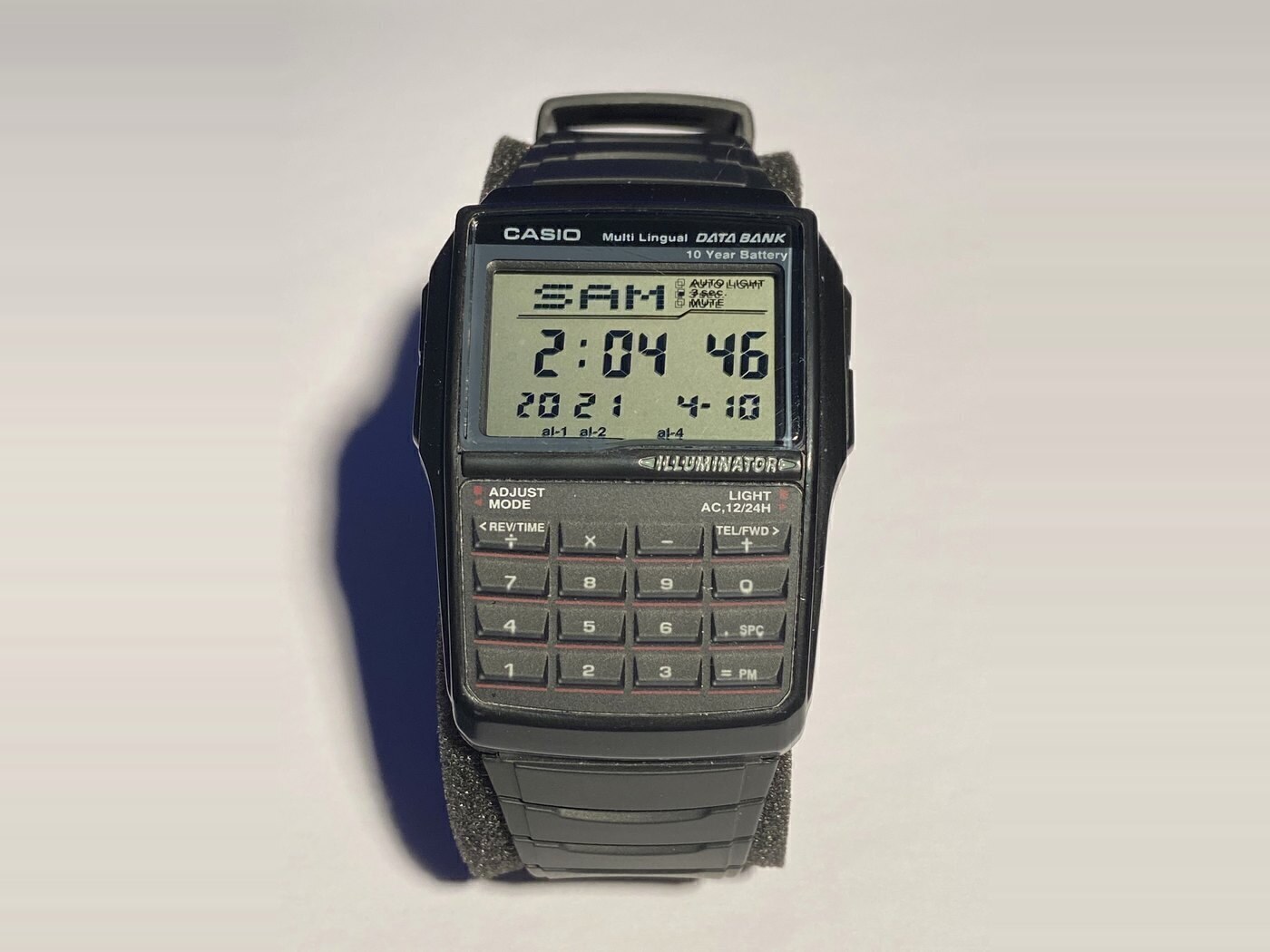
Casio DBC-32
DBC-32-1A
The chunky, resin-strapped Data Bank: same calculator, converter, telememo and ten-year battery as the DBC-611 in a wider case with a rubber band.
- Case
- 50.4 × 37.4 × 12.0 mm
- Weight
- 34 g (resin band)
- Battery
- CR2025
- Water resistance
- Listed by Casio as water resistant, without a published depth rating
Checked 19 Nov 2026 · Amazon
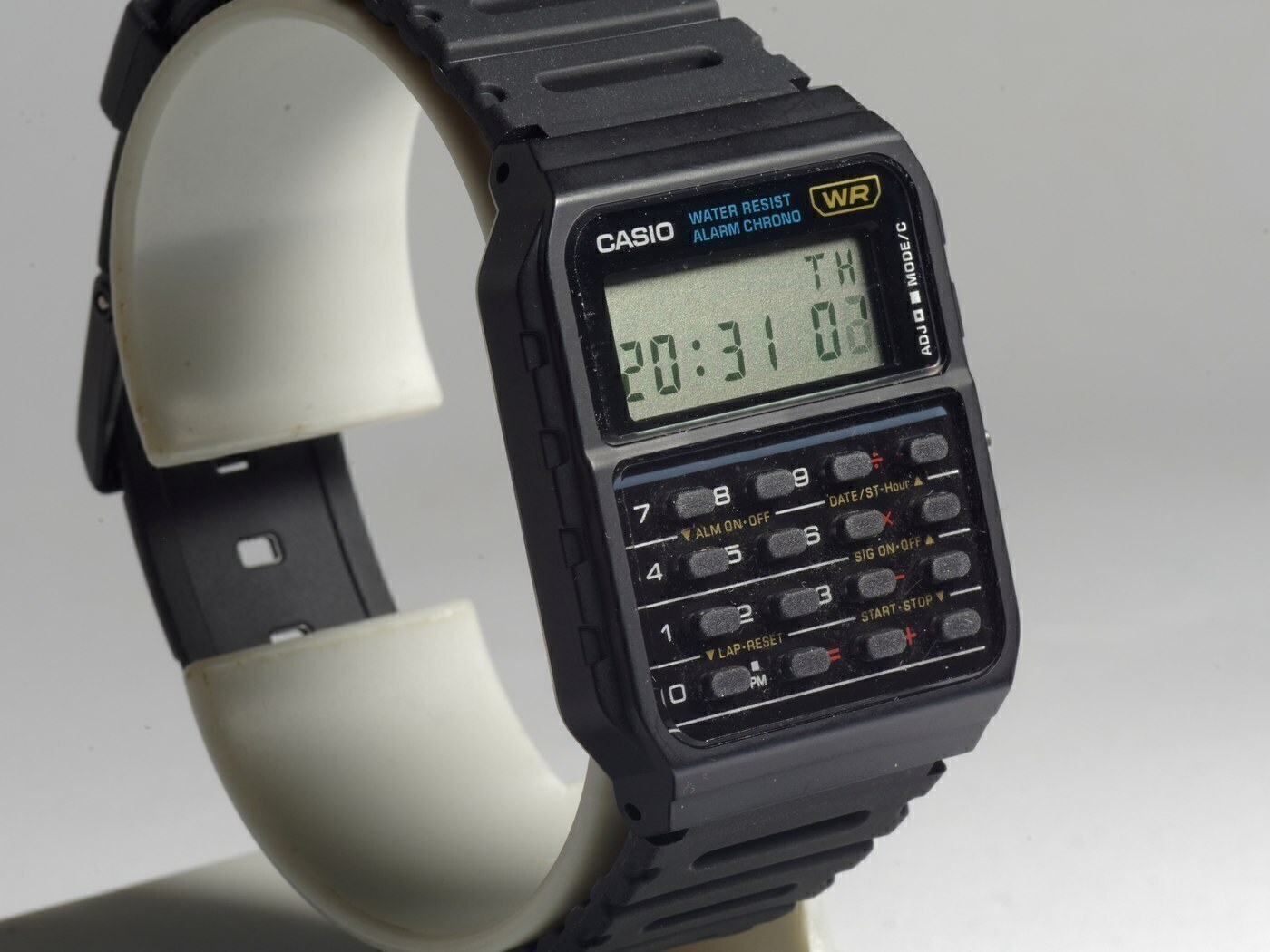
Casio CA-53W
CA-53W-1
The template calculator watch: a resin-cased 8-digit calculator with a full keypad, five-year battery and the lightest case of any model in this guide.
- Case
- 43.2 × 34.4 × 8.2 mm
- Weight
- 25 g
- Battery
- CR2016
- Water resistance
- Water Resistant (no depth rating published by Casio; not for swimming)
This article is editorial. Where a figure is given, it comes from the manufacturer’s published documentation and is dated on the page; where we are expressing a judgement, we say so. Something wrong? Tell us.