
Guide · 12 min read
Calculator Watches: Discover, Compare and Choose
A calculator watch is a wristwatch with a working numeric keypad and a calculator module built in. That sounds like a novelty, and for most of the last forty years it has…
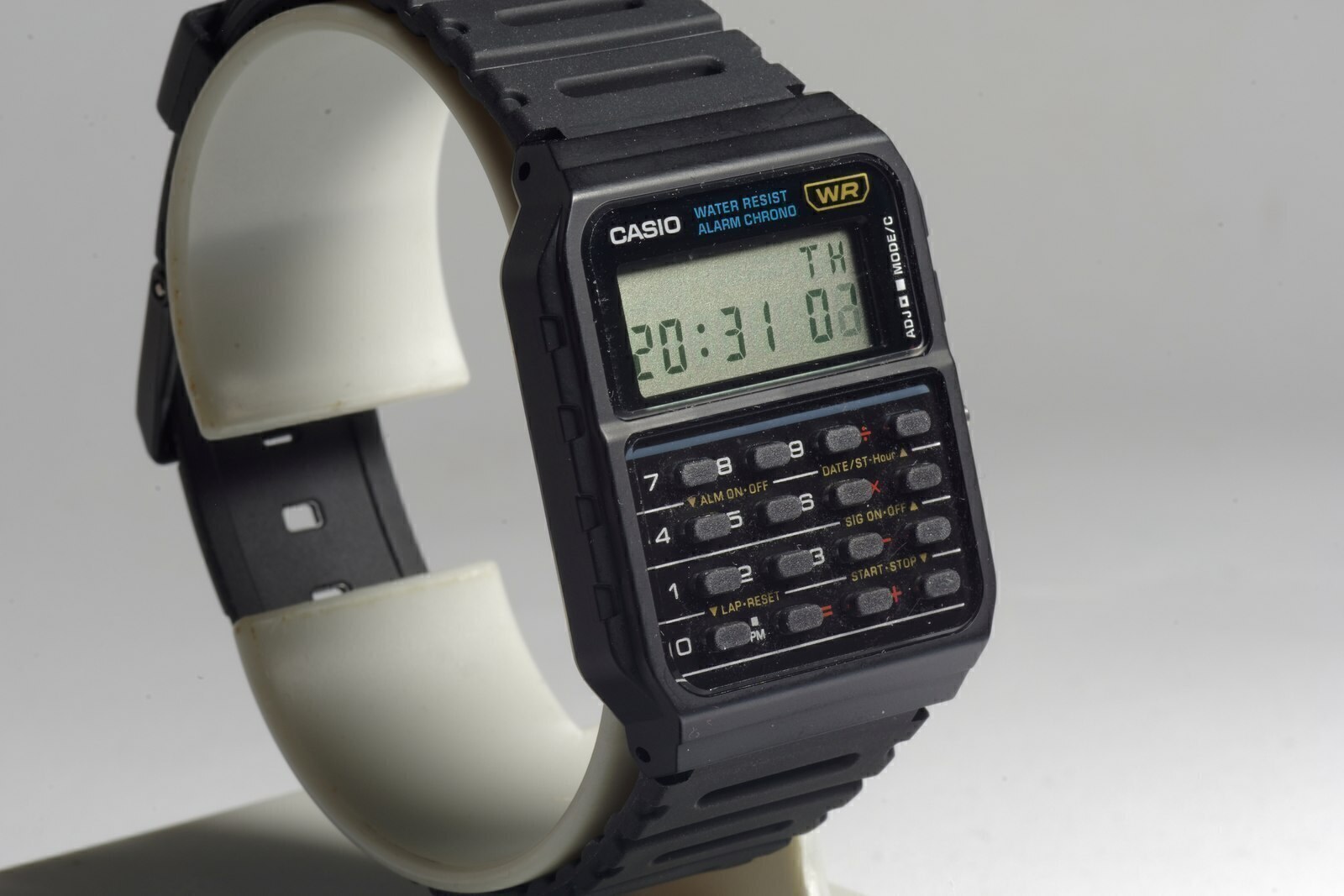
A calculator watch is a wristwatch with a working numeric keypad and a calculator module built in. That sounds like a novelty, and for most of the last forty years it has been treated as one — but the format has outlived almost every other piece of personal electronics from its era. While digital watches with television remotes, thermometers and language translators disappeared, the calculator watch stayed in production, largely unchanged, because it solves one problem well: arithmetic you want to do without reaching for something else.
This guide covers the models that are actually worth considering today, what their specifications really mean, how to tell a genuinely useful calculator watch from a decorative one, and where the vintage examples fit in. Everything on this page is drawn from manufacturer documentation or stated as our own judgement — we do not invent testing, and we do not publish a price we have not seen.
What makes a calculator watch different?
Three things separate a calculator watch from a digital watch with a stopwatch.
The keypad is the interface. A calculator watch has ten digit keys, four arithmetic operators, at least one clear key and an equals key — sixteen to twenty buttons on a case that is typically 33 to 37 mm wide. Because the keypad occupies the bottom half of the face, the display is pushed upward and made small. There is no calculator watch with a large display and a full keypad, because the geometry does not allow it.
Digit capacity is fixed. Nearly every calculator watch made uses an eight-digit calculator. That is not a cost-saving shortcut; it is what an eight-segment LCD can show in the space available. Eight digits covers most everyday arithmetic and rules out anything that needs scientific notation.
Calculation is a mode, not an app. On a Casio module, the calculator is one of several modes you cycle through with a single mode button. The number keys do different jobs depending on which mode you are in, which is the single biggest source of confusion for new owners — and the subject of our how-to guide.
Popular calculator watch models
Casio builds essentially the entire current market. Four references cover almost every buyer, and all four share the same underlying design language and a similar eight-digit calculator.
The four models that matter
- Casio CA-53W — the archetype. Resin case, 43.2 × 34.4 × 8.2 mm, 25 g, resin band, CR2016, five-year battery. The model worn in Back to the Future, and the lightest watch here.
- Casio CA-500WE — the same module in a chrome-plated resin case on a stainless steel bracelet. Identical footprint, 53 g. The dressy option.
- Casio DBC-611 — the Data Bank. Wider case at 46.5 × 33.1 × 8.7 mm, 48 g, steel band, amber backlight, currency converter, 25-entry data bank, ten-year battery.
- Casio DBC-32 — the same Data Bank feature set in a much larger resin-cased body, 50.4 × 37.4 × 12.0 mm, 34 g on a resin band. The most comfortable of the Data Banks and the largest watch in this guide.
There is also the CA-53WF, which is not a separate design: it is the CA-53W offered in different colourways. We treat it honestly as such on its model page rather than dressing it up as a new watch.
| Specification | Casio CA-500WECA-500WE-1A | Casio DBC-611DBC-611-1 | Casio DBC-32DBC-32-1A | Casio CA-53WFCA-53WF-1B / CA-53WF-3B / CA-53WF-8B | Casio CA-53WCA-53W-1 |
|---|---|---|---|---|---|
| Case size (L × W × H) | 43.2 × 34.4 × 8.2 mm | 46.5 × 33.1 × 8.7 mm | 50.4 × 37.4 × 12.0 mm | 43.2 × 34.4 × 8.2 mm | 43.2 × 34.4 × 8.2 mm |
| Weight | 53 g | 48 g | 34 g (resin band) | 25 g | 25 g |
| Case / bezel | Resin with chrome plating | Resin | Resin | Resin | Resin |
| Band | Stainless steel bracelet, adjustable clasp, 150–205 mm band size | Stainless steel band with adjustable clasp | Resin band | Resin | Resin |
| Display | Digital LCD (7-segment) | Digital LCD with LED backlight (amber) and auto light switch | Digital LCD with amber LED backlight and auto light switch | Digital LCD (7-segment) | Digital LCD (7-segment, fixed segments) |
| Calculator digits | 8 | 8 | 8 | 8 | 8 |
| Battery | CR2016 | CR1616 | CR2025 | CR2016 | CR2016 |
| Battery life | Approx. 5 years | Approx. 3 years | Approx. 10 years | Approx. 5 years | Approx. 5 years |
| Water resistance | Water Resistant (no depth rating published by Casio; not for swimming) | Water Resistant (Casio publishes no depth rating) | Listed by Casio as water resistant, without a published depth rating | Water Resistant (no depth rating published by Casio) | Water Resistant (no depth rating published by Casio; not for swimming) |
| Light | None | LED | LED | None | None |
| Verified price | Not verified | Not verified | Not verified | Not verified | $35.50 USD |
| Full page | Details → | Details → | Details → | Details → | Details → |
How the models compare
The table below uses only figures published by Casio. Where a manufacturer does not publish a value — water resistance on some Data Bank references, for instance — the cell says so instead of importing a retailer's guess.
What the specifications actually mean
Case size is the specification that decides whether you will wear it
Dimensions are given as length × width × thickness. The number that matters most in daily use is thickness: the CA-53W's 8.2 mm slips under a cuff, the DBC-32's 12.0 mm does not. Width matters for wrist fit: a 50.4 mm case overhangs a wrist under roughly 16 cm. Length — the lug-to-lug measurement — determines whether the case sits flat or floats.
Weight tells you more than you expect
25 g and 53 g do not sound far apart. They feel like different categories of object. The CA-53W disappears on the wrist; the CA-500WE announces itself. If you wear a watch to bed or while typing, weight is the specification you will notice most often.
Battery type predicts your maintenance
The CA-53W and CA-500WE take a CR2016 and last about five years. The DBC-611 and DBC-32 take a CR2025 and last about ten. That difference is mostly down to the larger cell and a lower-draw module. Five years is long enough that most owners will need one replacement in the life of the watch; ten years means most will never need one. Our battery guide covers how the replacement works.
Water resistance is where specifications get slippery
Casio lists several of these watches as “Water Resistant” while publishing no depth rating for the specific reference. That is materially different from a 50 m or 100 m rating. Treat “Water Resistant” with no number as splash protection: rain and hand-washing are fine, swimming is not. If a retailer quotes a depth rating the manufacturer's specification sheet does not mention, trust the specification sheet.
The calculator itself varies less than you would think
All four models do the four arithmetic operations with constant calculation. The Data Bank pair add a two-rate currency converter and a sign-change key. Where they differ is display and keypad spacing: wider cases give wider displays and more space between keys, which is why the DBC-32 is noticeably easier to calculate on than the CA-53W despite sharing the same eight-digit capacity.
How to choose a calculator watch
Start with the question you will actually be asking it, and work backwards.
- “I want the icon.” Buy the CA-53W. It is the reference design, it is the least expensive, and it is the one people recognise.
- “I want to wear it with a shirt.” Buy the CA-500WE. The steel bracelet and chrome bezel change how the watch reads entirely.
- “I want to use the calculator after dark.” Buy the DBC-611 or DBC-32. Both have an amber LED backlight; neither CA-series model does.
- “I have a small wrist.” Avoid the DBC-32. Its 50.4 × 37.4 mm case is genuinely large. The CA-53W at 34.4 mm across is the safest fit.
- “I want a watch I will never think about.” The DBC-32 with its ten-year battery and replaceable resin band is the lowest-maintenance option.
Two things we would not recommend: paying a premium for a colourway on the assumption that it is a different model, and buying a vintage calculator watch as a first purchase. Vintage modules fail in ways that cannot be repaired economically.
Calculator watch styles and designs
The current line divides into two families. The CA series is the original format: a slim octagonal case, a two-line display and a keypad printed directly onto the face. The Data Bank series is wider and thicker, with a separate recessed keypad panel, a domed crystal and — crucially — a backlight.
Within those families the variables are finish and band. Chrome-plated cases with steel bracelets read as formal; black resin reads as utilitarian; the pale resin colourways sit somewhere in between. We break the current options down by finish in our guides to metal bracelet models and resin strap models.
Vintage calculator watches
The history is genuinely interesting and considerably deeper than most retellings suggest. The first commercially sold calculator wristwatch was the Pulsar Time Computer Calculator, launched in 1975 by Pulsar — then a division of the Hamilton Watch Company — with an LED display and a keypad that needed a stylus. The Hewlett-Packard HP-01 followed in 1977 as a serious calculator in watch form. Casio's contribution was scale: inexpensive LCD models that put the format in schools.
Buying vintage is a different exercise from buying current. The failure point is the LCD and the module, not the case or the strap, and replacement parts come from donor watches. Our vintage calculator watch guide covers the models worth knowing and the checks to run before you pay for one, and the full history follows the format from 1975 to the present.
Frequently asked questions
We answer the questions that come up most often below — on water resistance, batteries, whether the calculator still works the way you expect, and whether these watches are still being made.
Where to go next
If you have narrowed it down to a model, our comparison tool puts any three side by side on the specifications that actually differ. If you are still choosing between the two families, the best calculator watches page sets out the criteria we use and which model wins on each. And if you have bought one and cannot get the calculator into the mode you want, start with the how-to guide and the manual index.
The models in detail
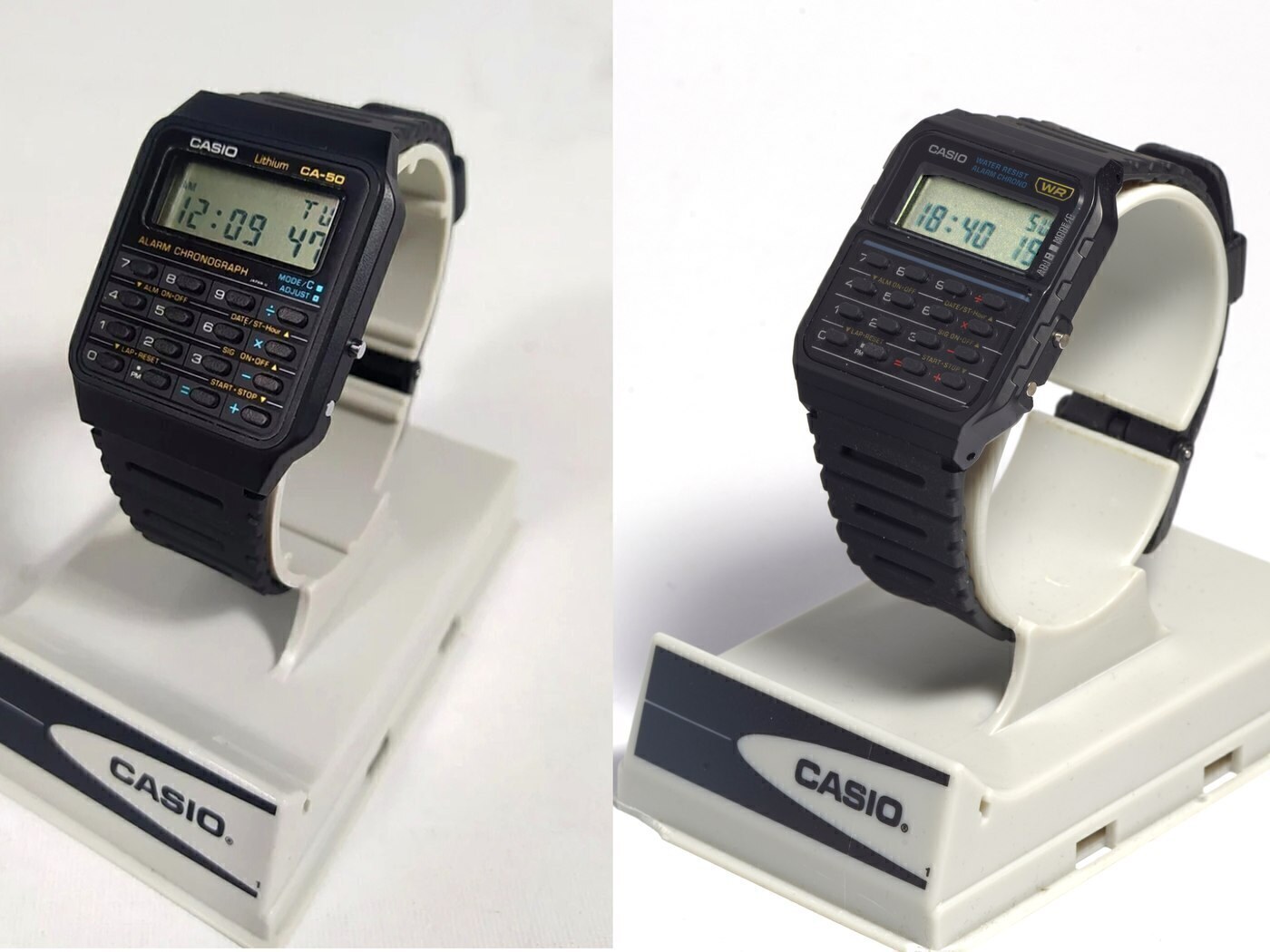
Casio CA-500WECA-500WE-1A
The same calculator module as the CA-53W in a chrome-plated case on a stainless steel bracelet — a dressier take that costs 28 grams in weight.
- Weight: 53 g
- Battery: CR2016 · Approx. 5 years
- Light: None
- Water resistance: Water Resistant (no depth rating published by Casio; not for swimming)
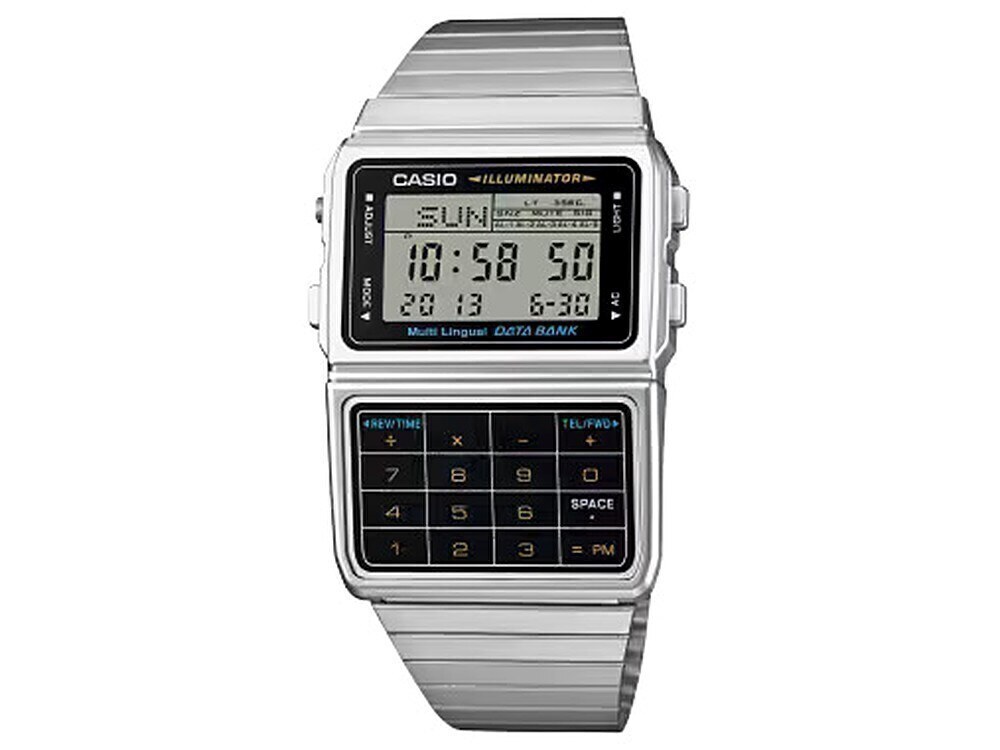
Casio DBC-611DBC-611-1
The Data Bank calculator watch: an 8-digit calculator with currency conversion, a 25-entry phone book, five alarms and an amber LED light, on a steel band.
- Weight: 48 g
- Battery: CR1616 · Approx. 3 years
- Light: LED
- Water resistance: Water Resistant (Casio publishes no depth rating)
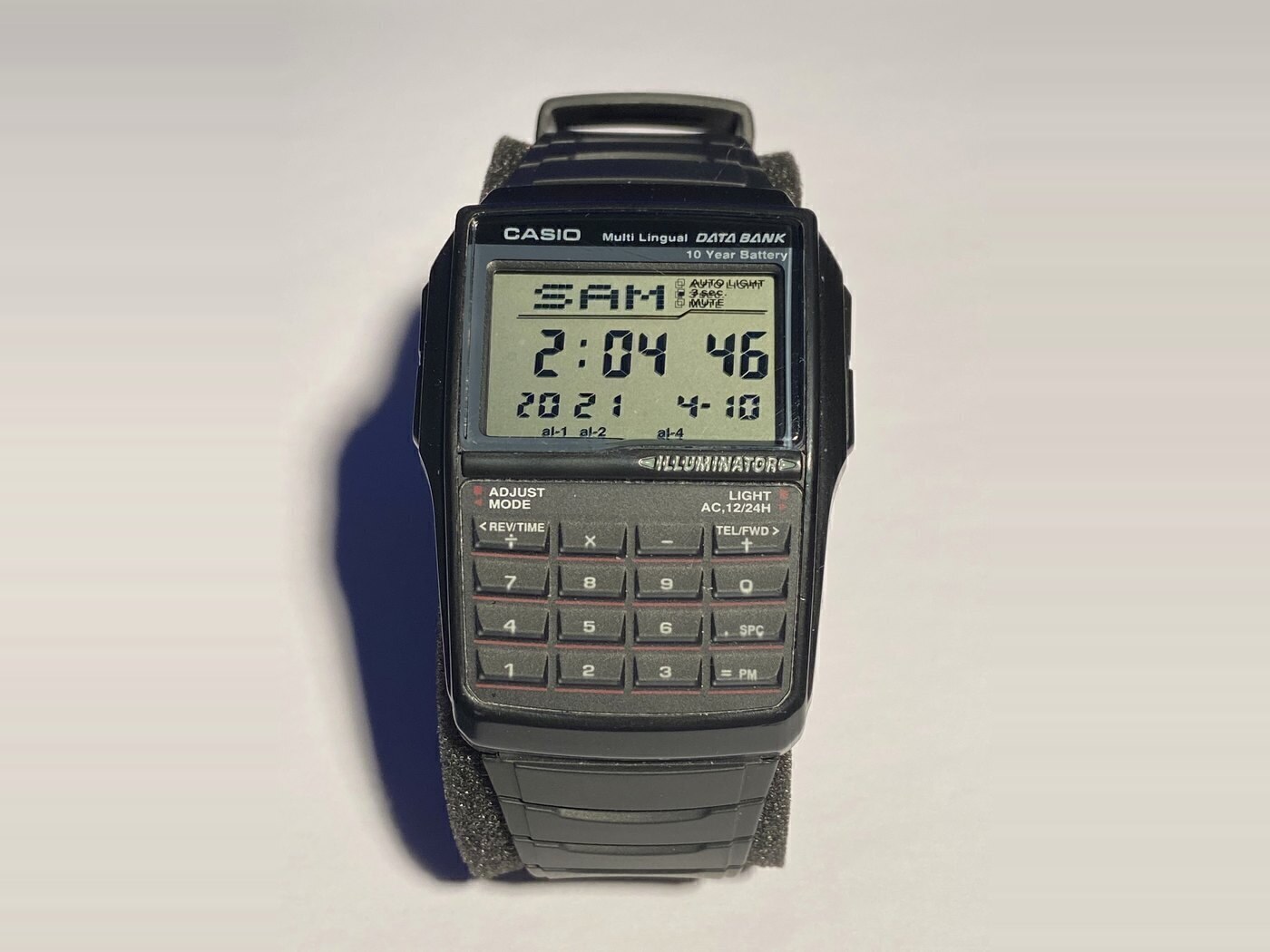
Casio DBC-32DBC-32-1A
The chunky, resin-strapped Data Bank: same calculator, converter, telememo and ten-year battery as the DBC-611 in a wider case with a rubber band.
- Weight: 34 g (resin band)
- Battery: CR2025 · Approx. 10 years
- Light: LED
- Water resistance: Listed by Casio as water resistant, without a published depth rating
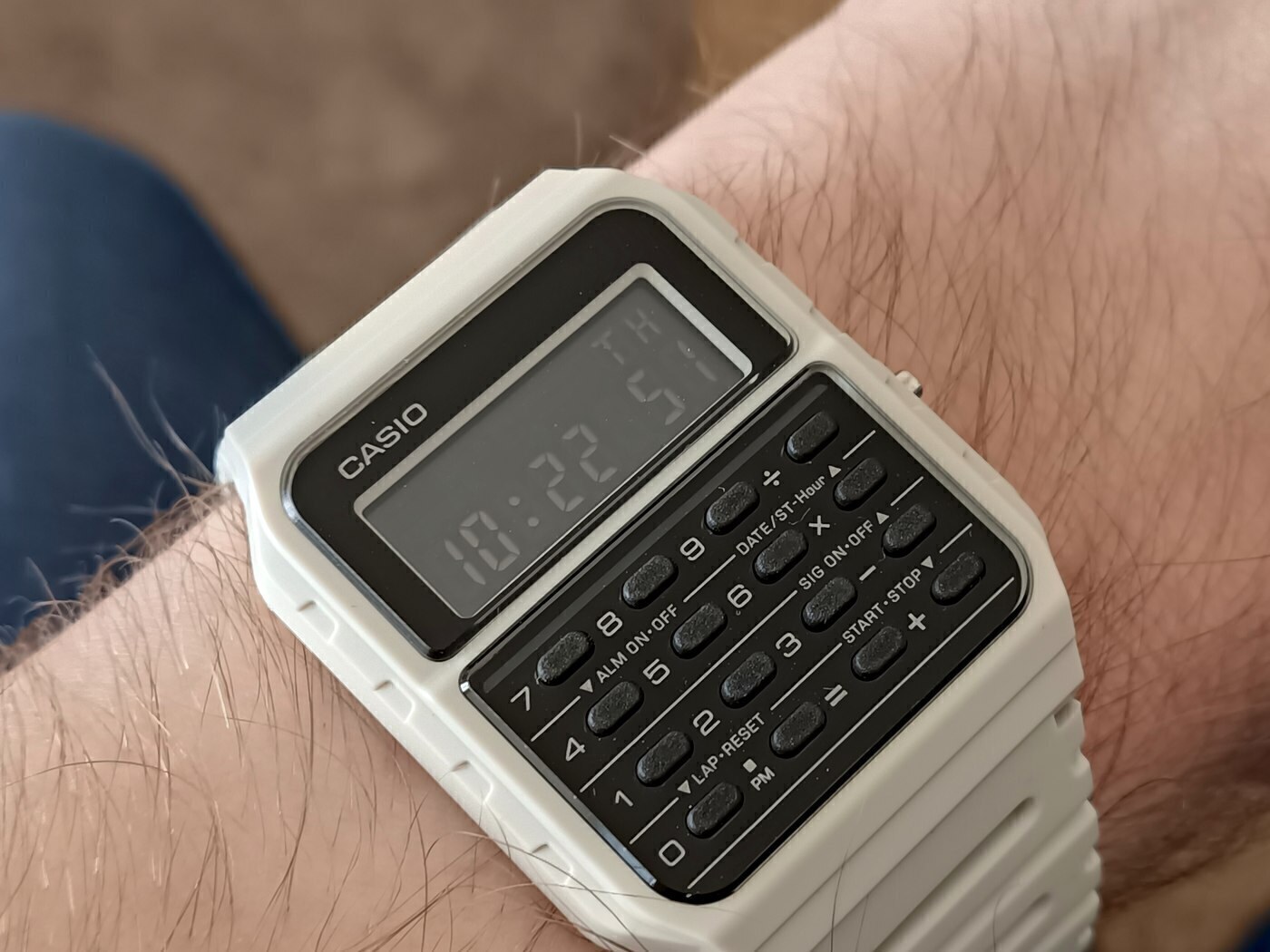
Casio CA-53WFCA-53WF-1B / CA-53WF-3B / CA-53WF-8B
Not a different watch — the CA-53W under its colourway references. Same 43.2 mm case, same module, same calculator; different case and band colours.
- Weight: 25 g
- Battery: CR2016 · Approx. 5 years
- Light: None
- Water resistance: Water Resistant (no depth rating published by Casio)
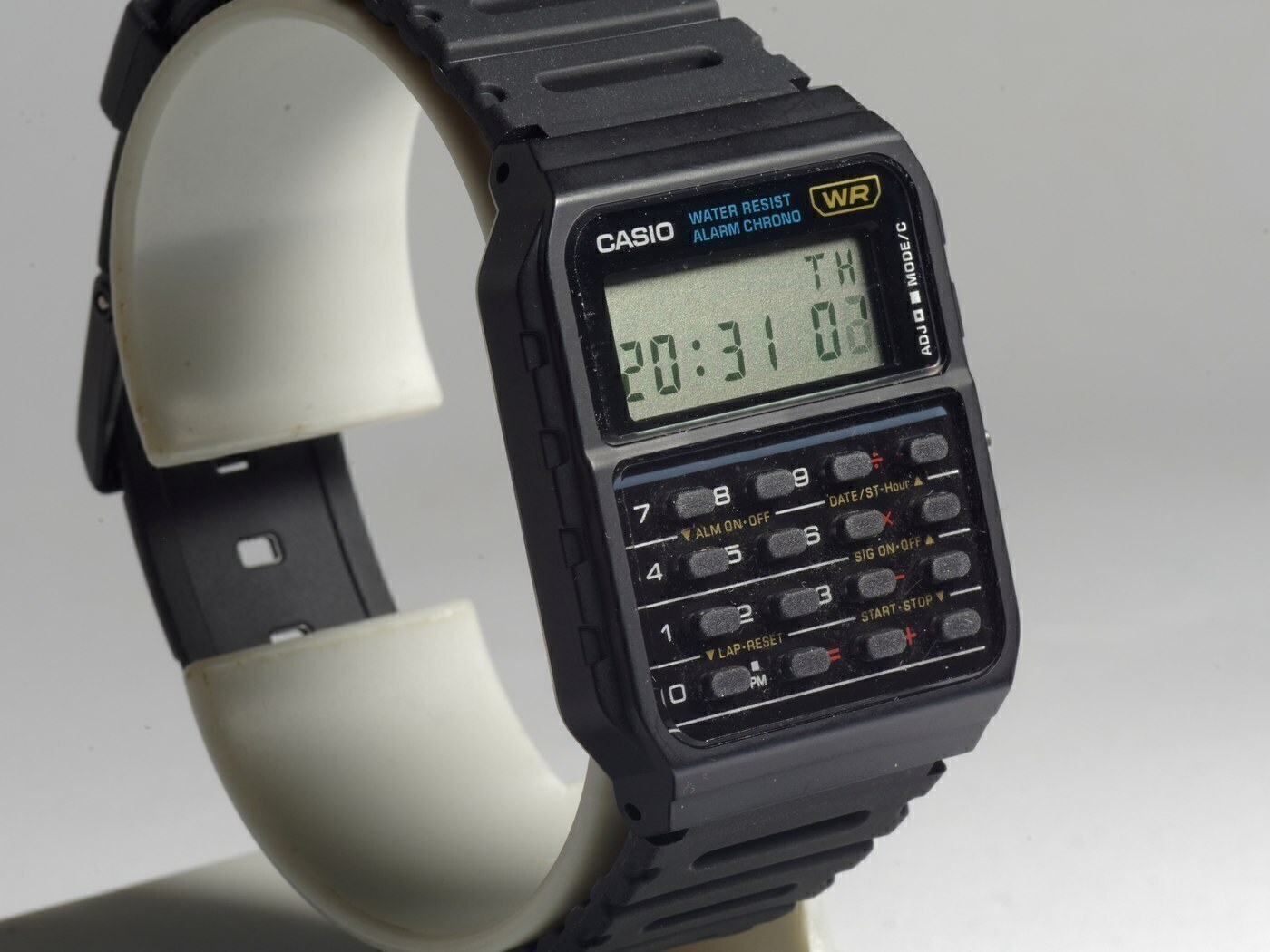
Casio CA-53WCA-53W-1
The template calculator watch: a resin-cased 8-digit calculator with a full keypad, five-year battery and the lightest case of any model in this guide.
- Weight: 25 g
- Battery: CR2016 · Approx. 5 years
- Light: None
- Water resistance: Water Resistant (no depth rating published by Casio; not for swimming)
Frequently asked questions
What is the best calculator watch?
There is no single answer, because the models optimise for different things. The Casio CA-53W is the best choice for a first calculator watch and for the lightest wear; the DBC-611 is the best if you want a backlight and a ten-year battery; the CA-500WE is the best if you want a metal bracelet. Our buying guide explains the criteria behind each recommendation.
Are calculator watches still made?
Yes. Casio continues to produce the CA-53W, CA-500WE, DBC-611 and DBC-32 as current catalogue items. Availability differs by region and colourway, but the format has never gone out of production.
Are calculator watches waterproof?
Most are not, in the sense that matters. Casio lists several references as “Water Resistant” without publishing a depth rating, which means splash protection rather than swimming. The DBC-611’s published specification sheet includes no water-resistance rating at all. Take any of these watches off before swimming.
Can a calculator watch do more than four arithmetic operations?
The standard Casio module does the four operations with constant calculation, plus percentage and square root on models with those keys. The Data Bank models add a fixed-rate currency converter. None of them is a scientific calculator — for trigonometry, logarithms and hexadecimal you would be looking at vintage models such as the Casio CFX-400.
How accurate is the calculator on a calculator watch?
Exactly as accurate as the eight digits it displays. There is no rounding error to worry about within eight digits; the limitation is capacity, not precision. A calculation that needs a ninth digit will simply not display in full.
Do I need a stylus to use a calculator watch?
Not on a Casio. The keypad keys on the CA and Data Bank series are sized for a thumb or fingernail. The stylus was a feature of the earliest 1970s models, whose capacitive keypads were too small to press with a finger.
Models referenced in this guide
Every specification on these pages is sourced from manufacturer documentation.
Casio CA-500WE
CA-500WE-1A
The same calculator module as the CA-53W in a chrome-plated case on a stainless steel bracelet — a dressier take that costs 28 grams in weight.
- Case
- 43.2 × 34.4 × 8.2 mm
- Weight
- 53 g
- Battery
- CR2016
- Water resistance
- Water Resistant (no depth rating published by Casio; not for swimming)
Casio DBC-611
DBC-611-1
The Data Bank calculator watch: an 8-digit calculator with currency conversion, a 25-entry phone book, five alarms and an amber LED light, on a steel band.
- Case
- 46.5 × 33.1 × 8.7 mm
- Weight
- 48 g
- Battery
- CR1616
- Water resistance
- Water Resistant (Casio publishes no depth rating)
Checked 19 Nov 2026 · Casio official site
Casio DBC-32
DBC-32-1A
The chunky, resin-strapped Data Bank: same calculator, converter, telememo and ten-year battery as the DBC-611 in a wider case with a rubber band.
- Case
- 50.4 × 37.4 × 12.0 mm
- Weight
- 34 g (resin band)
- Battery
- CR2025
- Water resistance
- Listed by Casio as water resistant, without a published depth rating
Checked 19 Nov 2026 · Amazon
Casio CA-53W
CA-53W-1
The template calculator watch: a resin-cased 8-digit calculator with a full keypad, five-year battery and the lightest case of any model in this guide.
- Case
- 43.2 × 34.4 × 8.2 mm
- Weight
- 25 g
- Battery
- CR2016
- Water resistance
- Water Resistant (no depth rating published by Casio; not for swimming)
This article is editorial. Where a figure is given, it comes from the manufacturer’s published documentation and is dated on the page; where we are expressing a judgement, we say so. Something wrong? Tell us.