
Tutorial · 6 min read
Watch Size Calculator
Working out what size watch suits a wrist is usually done by memory, guesswork or by copying whatever the last watch was. This tool does it from one measurement instead: your…
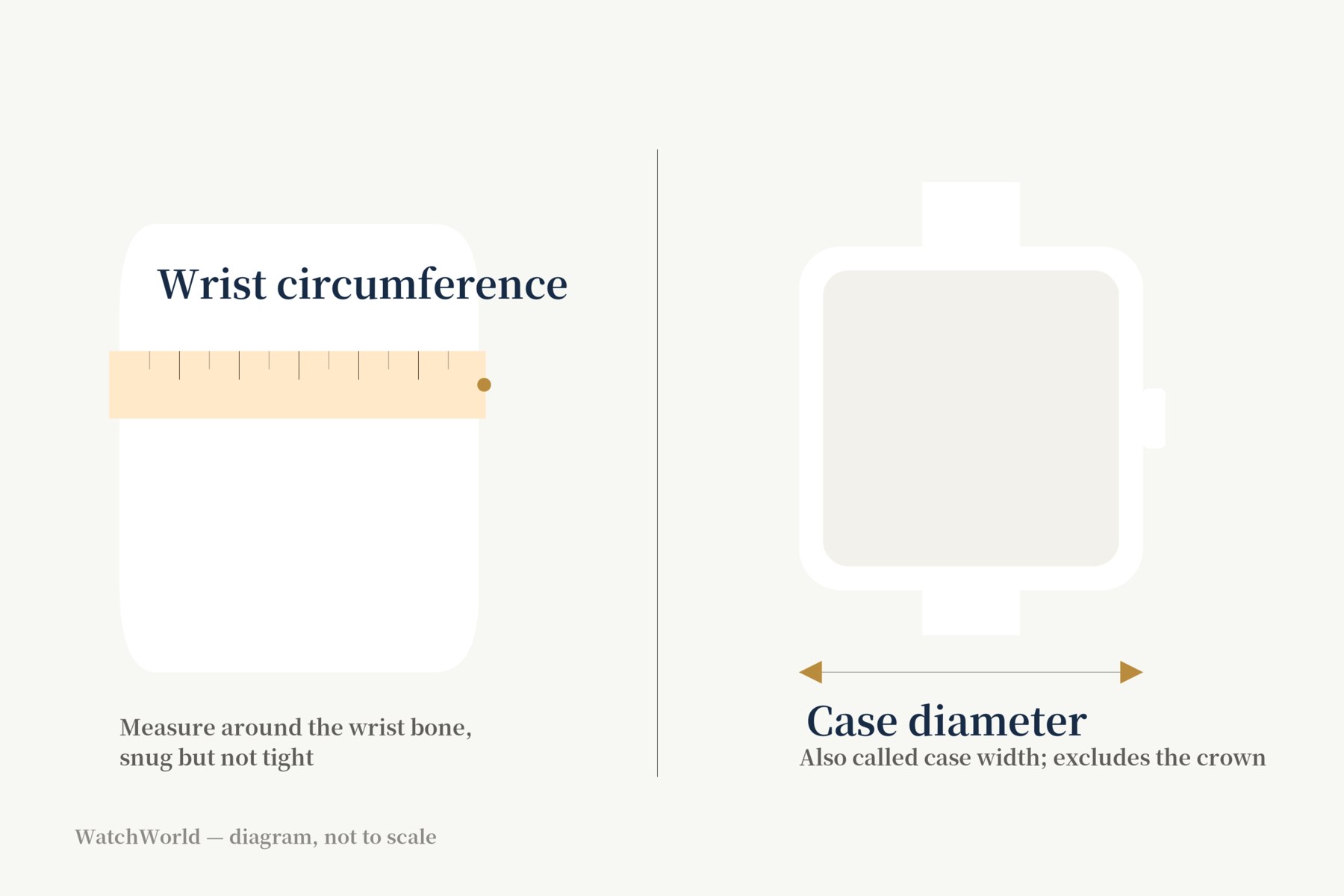
Working out what size watch suits a wrist is usually done by memory, guesswork or by copying whatever the last watch was. This tool does it from one measurement instead: your wrist circumference. It gives you a case-diameter range to shop within and, more usefully, the maximum lug-to-lug length that should sit on your wrist without the lugs hanging over the edge.
Before you use it, one honest caveat. There is no industry standard for watch sizing. The guidance published by watch brands, retailers and magazines disagrees by several millimetres on the same wrist measurement, and none of it is written down in a technical standard. What follows is a reasonable method, presented with the method visible so you can judge it, not a guarantee of fit.
How to measure your wrist for a watch
You need a soft tape measure, or a strip of paper and a ruler. Wrap it around your wrist just past the wrist bone, where a watch actually sits, and pull it snug — you should be able to slide a fingertip underneath, not a finger. Note the figure. That is your wrist circumference, and it is the number the calculator uses.
If you have no tape measure, wrap a strip of paper around the wrist, mark where it overlaps, lay it flat and measure the marked length against a ruler. The result will be within a millimetre or two, which is well inside the margin this method works to.
There is a second measurement worth taking, and almost nobody bothers. Measure straight across the flat top of your wrist, from the point where it starts to curve down on one side to the point where it curves down on the other. That flat span is the landing zone for a watch case. If a watch's lug-to-lug length is longer than that span, the lugs overhang the curve and the watch perches rather than sits. The calculator takes this as an optional input, and when you supply it, it uses your measurement instead of its own estimate.
Why lug-to-lug matters more than diameter
Case diameter gets all the attention because it is the number printed on every product page. It is a poor predictor of fit. Compare two watches: one is 40 mm across but 50 mm from lug tip to lug tip, the other is 42 mm across but 47 mm long. The second is the bigger watch by diameter and the smaller watch on the wrist.
Lug-to-lug is the full length of the case along your arm. It is what determines whether the watch beds down flat or rocks on the curve of your wrist, and it is what determines whether the bracelet ends point at the floor or at your forearm. If a listing does not give it, that is a gap worth chasing before you buy — a maker that publishes diameter but not lug-to-lug is telling you only half the story.
Thickness is the third figure. It does not affect whether a watch fits in the abstract, but above roughly 13 mm a case starts catching on a shirt cuff and sitting proud under a sleeve. The calculator deliberately does not predict a thickness ceiling: thickness is a property of the watch, not of your wrist, so any figure it produced would be invented. Use it as a filter when you read the listing instead.
The calculator
Enter your wrist circumference, switch the units if you work in inches, and read the result. Everything runs in your browser; no measurement is transmitted anywhere. The Reset button returns the form to its starting state.
How the numbers are produced
The calculator derives two bands from a wrist circumference w, both expressed as a percentage of w:
- Comfortable band: 20%–24.5% of w. A 165 mm wrist gives 33–40 mm, a 178 mm wrist 35.5–43.5 mm and a 190 mm wrist 38–46.5 mm before style adjustment. This is the conservative, "definitely not too big" range.
- Workable band: 18%–27% of w. Wider, and where most people actually land once the watch is on. A 178 mm wrist gets 32–48 mm here, which is deliberately generous.
- Lug-to-lug ceiling: 28% of w, clamped to 40–56 mm — about 50 mm on a 178 mm wrist. If you supply a flat wrist width, that number replaces the estimate.
- Flat wrist width: 32% of w by default, clamped to 46–70 mm. Used only for the scale drawing unless you override it.
The style selector shifts the bands by 6% either way, because a dress watch is expected to sit smaller than a sports watch on the same wrist. That is a convention about appearance, not a rule about fit.
Why those percentages? Because they land inside the ranges that published guidance broadly agrees on — three independent sizing guides put a 6.5-inch wrist at 36–40 mm, a 7-inch wrist at 38–42 mm and a 7.5-inch wrist at 40–44 mm — while still diverging in the same directions those sources diverge from each other. They are a defensible synthesis, not an extracted standard. Anyone presenting a single authoritative formula for this is overselling what exists.
The flat wrist width deserves its own note. On average it is roughly a third of the circumference, but the variation between individuals is much wider than that for the diameter estimate, which is why the calculator asks for it rather than trusting the estimate when you can measure it.
What the result means, and what it does not
The comfortable band is the safest shortlist. The workable band is the full range you should not dismiss without trying. Neither accounts for the shape of the case: a round dial with a thin bezel shows more dial in the same diameter than a cushion case with a wide bezel, and a watch with a large dial opening reads bigger than a watch of the same size with a small one. Wrist shape matters too — a flat wrist carries a larger case than a round wrist of the same circumference.
Two practical checks beat any calculator. First, cut a rectangle of card to the case diameter and lug-to-lug figures from the listing, lay it on your wrist and look at it. It takes ten seconds and settles arguments that a table cannot. Second, if the watch is already in a shop window, put it on.
Sizing a calculator watch specifically
Rectangular calculator watches are quoted differently, and this trips people up. Casio lists the CA-53W as 43.2 × 34.4 × 8.2 mm. The first figure is the length of the case, top to bottom — the effective lug-to-lug — and the second is its width across the wrist. So on a wrist, a CA-53W reads as a slim 34 mm watch that happens to be unusually tall on the arm, which is why it fits wrists that would look overwhelmed by a 43 mm round case.
Compare that with a DBC-611 at 46.5 × 33.1 × 8.7 mm, or a DBC-32 at 50.4 × 37.4 × 12 mm. The DBC-32 is the one to think about: 12 mm thick and 50 mm long is a materially bigger object than the numbers suggest if you read only the width. Our comparison of the current range lays those figures side by side.
Where this goes next
Once you have a range, the more useful question is what you want the watch for. Our calculator watch buying guide covers the models in this catalogue, and the function guide explains what the keypads actually do. If you are sizing a watch to sell or to value rather than to wear, the valuation worksheet is the relevant page.
Interactive tool
Watch size calculator
Enter your wrist measurement to get a suggested case-diameter range and the maximum lug-to-lug length that should sit on your wrist without the lugs overhanging.
Suggested case diameter
30.5–46 mm
Comfortable band: 34–41.5 mm
- Max lug-to-lug
- 47.5 mm
- Estimated from circumference. Measure the flat wrist width for a real figure.
- Flat wrist width (landing zone)
- 54.5 mm
- Estimated at 32% of your circumference. Measuring it takes ten seconds and is more reliable.
This sits inside the range most published sizing guidance covers, so diameter is unlikely to be your constraint — lug-to-lug will be.
A guideline, not a guarantee. Published sizing advice disagrees by several millimetres either way, wrist shape varies, and a 40 mm watch with long lugs can overhang where a 42 mm watch with short lugs does not. If you can, cut a paper template to the case and lug-to-lug figures and rest it on your wrist before you buy.
Frequently asked questions
How accurate is a watch size calculator?
It is a starting filter, not a measurement of fit. Published sizing guidance disagrees by several millimetres for the same wrist, wrist shape varies between people with identical circumferences, and case design changes how a given diameter wears. Use the result to narrow a shortlist, then check lug-to-lug.
Should I measure my wrist in centimetres or inches?
Either. The calculator converts both, and switch units after typing if you need to. Most manufacturer sizing charts in the US are in inches, and most in Europe and Asia are in millimetres, so knowing both figures is useful when you shop.
Why does the calculator ask for lug-to-lug and not just diameter?
Because lug-to-lug decides whether the watch sits on your wrist. A case whose lugs are longer than the flat span of the top of your wrist will overhang and rock, no matter how reasonable the diameter looks. Diameter tells you how much dial you see; lug-to-lug tells you whether it fits.
What is a normal watch size for a man and for a woman?
Case diameters in current catalogues run from roughly 26 mm to 47 mm, and the same case can be sold to anyone. Sizing guidance in circulation clusters everyday watches between about 36 mm and 42 mm, but that is a fashion convention, not a rule, and it has moved up and down over the decades.
Does the calculator work for calculator watches?
Yes, with one caveat worth knowing. Calculator watches are rectangular, so the published figures are length × width × thickness rather than a single diameter. Read the length as the lug-to-lug equivalent and the width as the diameter. A CA-53W is 43.2 mm long by 34.4 mm wide, so it wears closer to a 34 mm round watch across the wrist than its length suggests.
This article is editorial. Where a figure is given, it comes from the manufacturer’s published documentation and is dated on the page; where we are expressing a judgement, we say so. Something wrong? Tell us.