
History · 11 min read
The History of the Calculator Watch
The calculator watch is a rare thing: a category of personal electronics that was invented in the 1970s, mass-produced in the 1980s, abandoned in the 1990s and is still in…
The calculator watch is a rare thing: a category of personal electronics that was invented in the 1970s, mass-produced in the 1980s, abandoned in the 1990s and is still in production today with essentially the same design. Understanding why requires looking at the three distinct moments that shaped it.
1975: the idea becomes a product
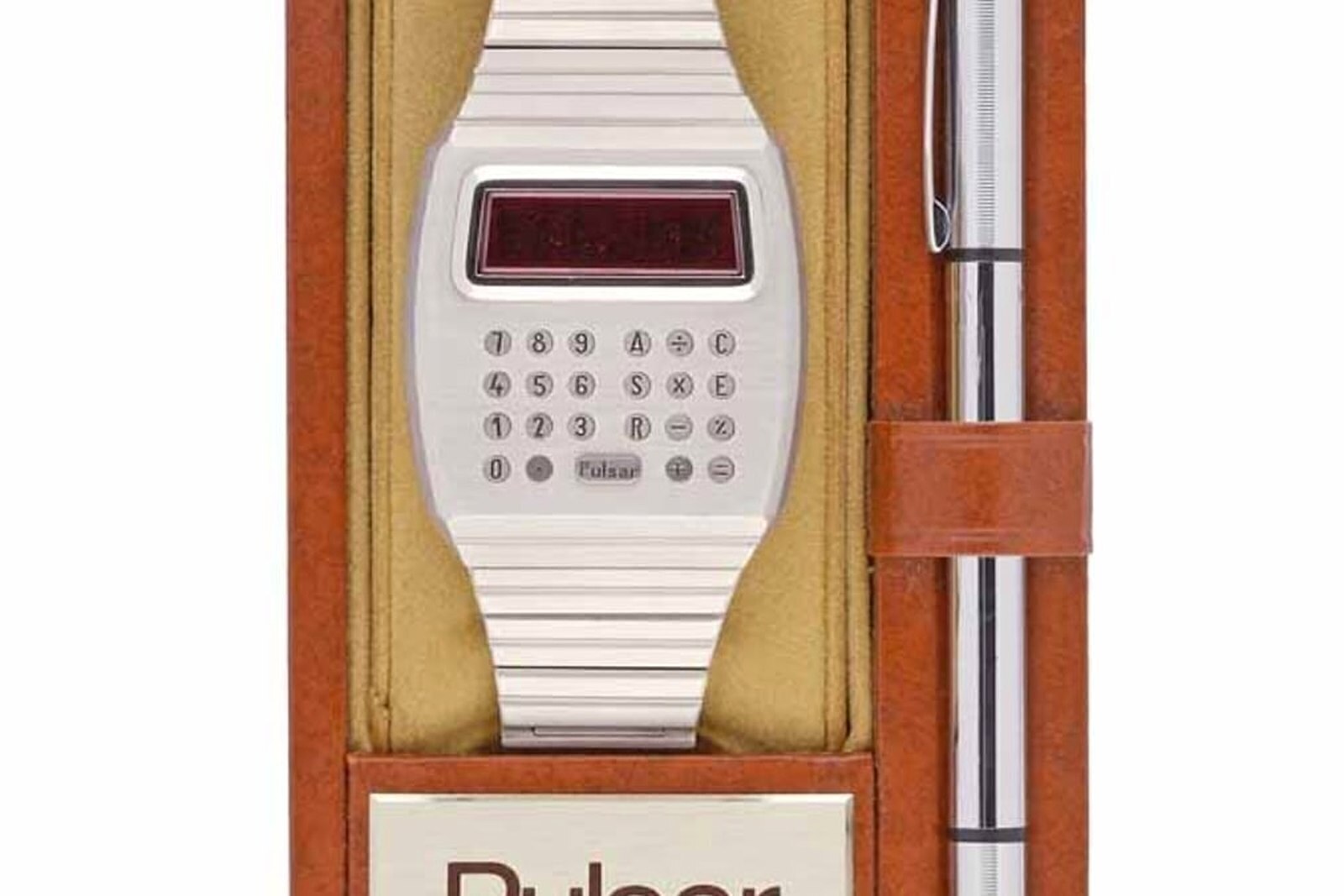
The first commercially sold calculator wristwatch was the Pulsar Time Computer Calculator, introduced in 1975 by Pulsar, then a division of the Hamilton Watch Company. It combined a red LED display with a numeric keypad, and it arrived at a time when a digital wristwatch was itself still a novelty.
Two details of the Pulsar matter to the story. The first is scale: the keypad was so small that the watch shipped with a stylus, because a finger could not reliably press the keys. The second is price — it was a luxury object, not a consumer one. The Pulsar established that computation could live on a wrist. It did not establish that anyone could afford it.
An example is held by the Deutsches Uhrenmuseum in Germany, which is where the photograph on this page comes from.
1977: the professionals take it seriously
Two years later, Hewlett-Packard released the HP-01. This is the pivotal moment for anyone interested in the calculator watch as an instrument rather than a curiosity: HP was a calculator company, and the HP-01 was built with the seriousness of its desktop machines. It cost considerably more than a good watch, and it was bought by people who wanted a calculator they could wear.
The HP-01 also demonstrates the ceiling of the format. Every function has to be reachable through a small number of keys that must also do other things, and the more capability you add, the less usable the interface becomes.
1977 to 1980: the shift to LCD
The change that made calculator watches mass-market was not conceptual but technological: the move from LED to LCD. An LED display is a light source and drains a battery accordingly; an LCD reflects ambient light and draws almost nothing. Once an LCD calculator could run for years on a button cell, the watch no longer had to be a luxury object.
Japanese manufacturers — Casio and Seiko among them — industrialised the format around this change, building calculator watches in plastic at prices schoolchildren could reach.
The 1980s: Casio's decade
Casio's contribution was scale and iteration. The company built calculator watches in enormous variety through the 1980s: slim two-line models in the CA series, wider Data Bank models with address books, and increasingly specialised designs.
Three examples from the period show how far the idea was pushed. The Casio TC-500 (1983) replaced physical keys with a capacitive touch surface — an interesting dead end, since touch surfaces of the era were unreliable and the design was not continued. The Casio CA-502 (1984) is a conventional calculator watch of the period and shows how settled Casio's design language already was. And the Casio CFX-400 (mid-1980s) was a genuine scientific calculator with trigonometry, logarithms and hexadecimal arithmetic across sixteen keys carrying three functions each.
The CFX-400 is the clearest illustration of why the format stopped developing. It could do far more than a CA-53W, and it was far harder to use. The keyboard had become the constraint, not the electronics.
The 1990s and after: survival by doing one thing
When digital watches gained databases, remote controls, thermometers and translators, the calculator watch looked like a transitional object that would be absorbed into something more capable. Instead the opposite happened. The multi-function digital watch disappeared, and the calculator watch — which did one small thing well and did not pretend otherwise — stayed in production.
Casio still sells the CA-53W, the CA-500WE, the DBC-611 and the DBC-32. The modules have changed little. The design has changed less. The eight-digit calculator, the 1/100-second stopwatch, the dual time and the auto-calendar are the same functions the format has offered since the mid-1980s, and they remain enough.
Why the design persisted
There is a straightforward engineering explanation. A calculator needs a keypad, a keypad needs space, and the wrist has a fixed amount of it. The 1980s reached the geometric optimum: a 34 mm-wide case will take a twenty-key pad and an eight-digit display, and no further miniaturisation makes the interface better. Nothing since has changed that constraint, which is why a watch designed in the 1980s still looks contemporary and why its replacement never arrived.
The cultural explanation is simpler still. The CA-53W was worn by Marty McFly in Back to the Future, and that association has kept the model in continuous demand for four decades. Nostalgia is a durable market.
Where to go from here
If the history has made you want one, the calculator watch guide sets out the current models and what their specifications mean. If it has made you want an old one, the vintage guide covers the models worth knowing and the checks to run before buying.
Timeline
- 1975
The Pulsar Time Computer Calculator
Pulsar, then a division of the Hamilton Watch Company, sells the first calculator wristwatch. LED display, and a keypad so small it shipped with a stylus.
Photo: Deutsches Uhrenmuseum (Museumsfoto), Wikimedia Commons · CC BY 3.0 DE - 1977
The Hewlett-Packard HP-01
HP builds a calculator watch with the seriousness of its desktop machines. Expensive, capable, and the high point of the format as a professional instrument.
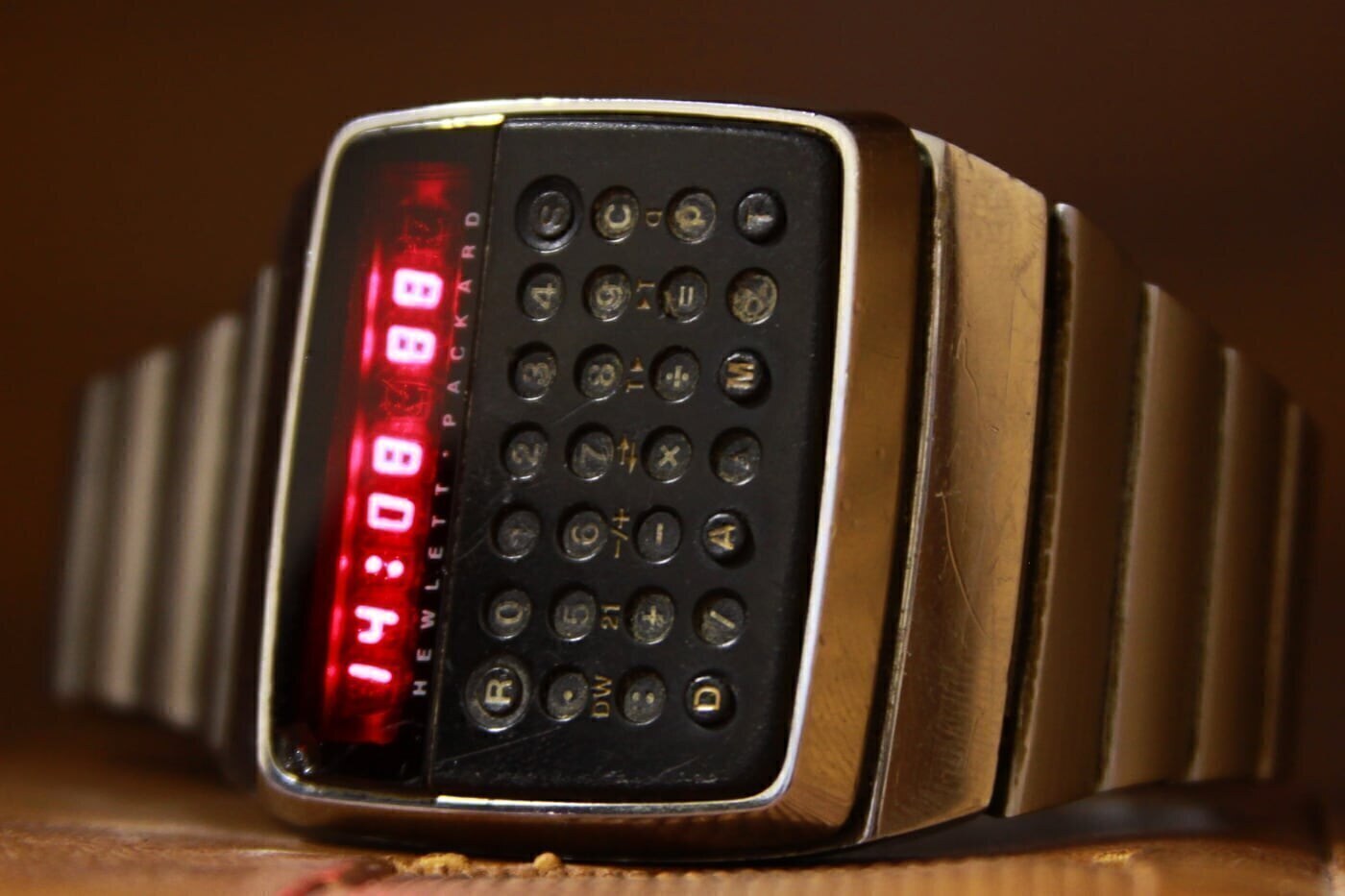
Photo: Antiquekid3, Wikimedia Commons · CC BY-SA 4.0 - Late 1970s
LED gives way to LCD
An LCD reflects ambient light instead of emitting its own, so a calculator module can run for years on a button cell. This is the change that makes the calculator watch affordable.
Photo: Wolfgang Stief, Wikimedia Commons · CC0 1.0 - 1980s
Casio industrialises the format
Casio builds calculator watches in enormous variety in moulded plastic at consumer prices. The design language that survives today is set in this decade.
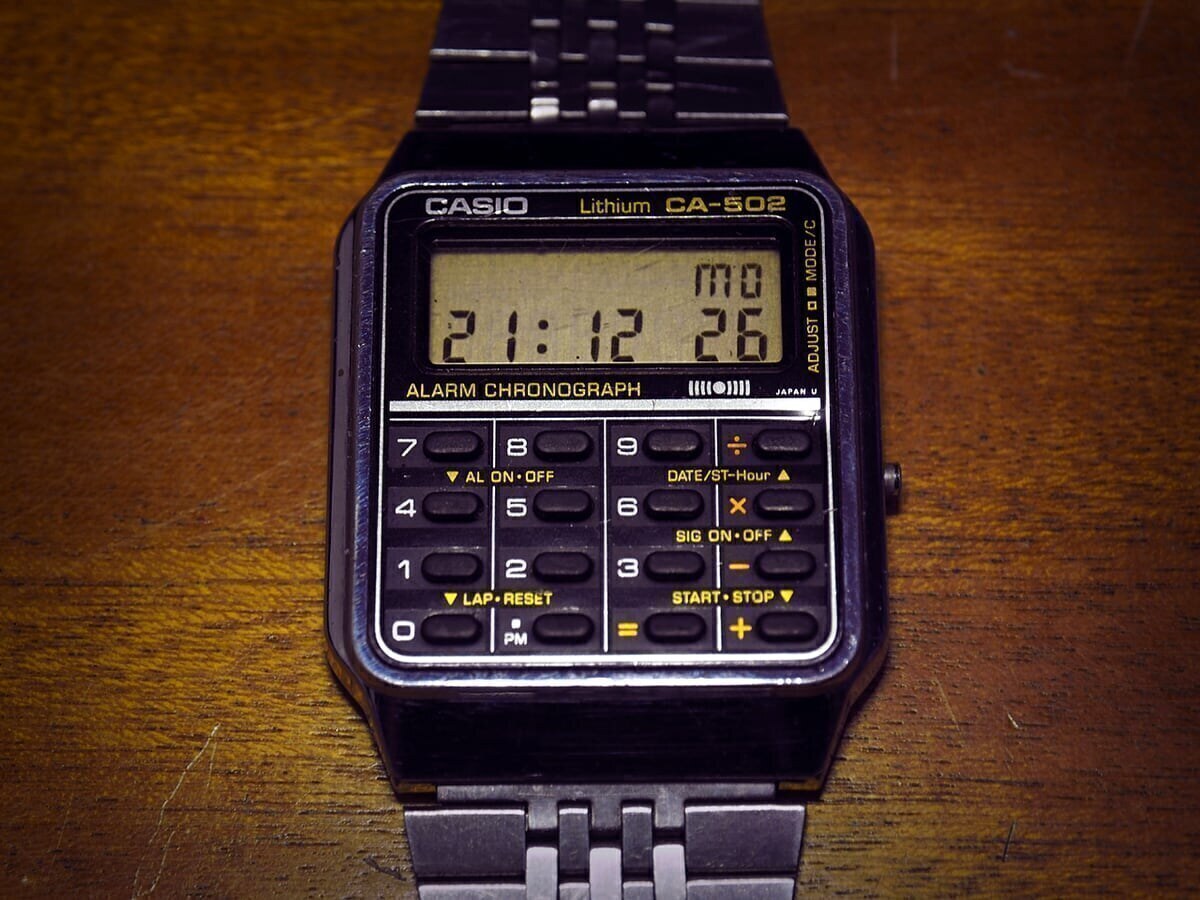
Photo: orion (Auckland, NZ), Wikimedia Commons · CC BY-SA 2.0 - 1983–85
The experiments
The Casio TC-500 replaces keys with a capacitive touch surface; the CFX-400 adds scientific functions across three-function keys. Both prove that the keyboard, not the electronics, is the limit.
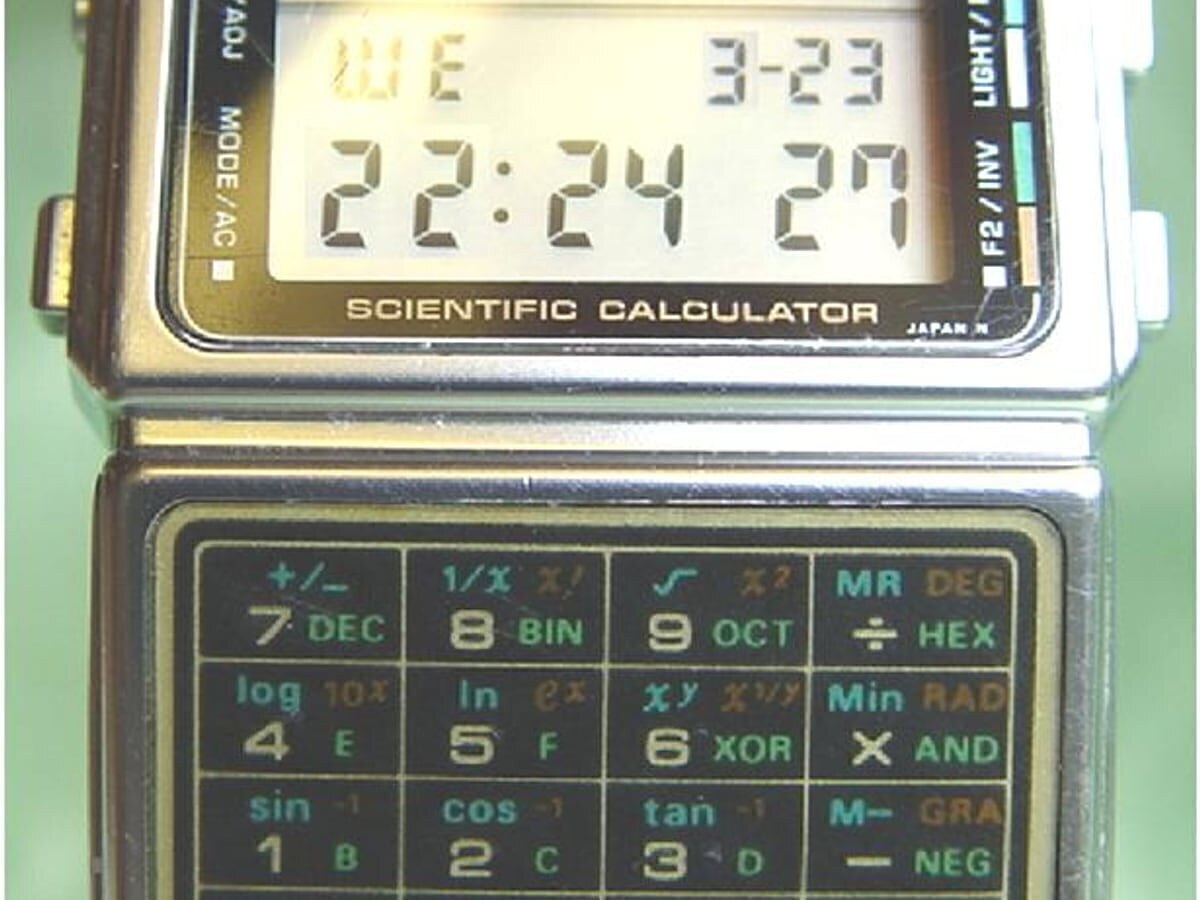
Photo: Septagram, English Wikipedia · public domain - 1990s onwards
Survival by doing one thing well
Multi-function digital watches disappear; the calculator watch does not. Casio keeps building the same eight-digit module, and the 1985 film association keeps demand alive.
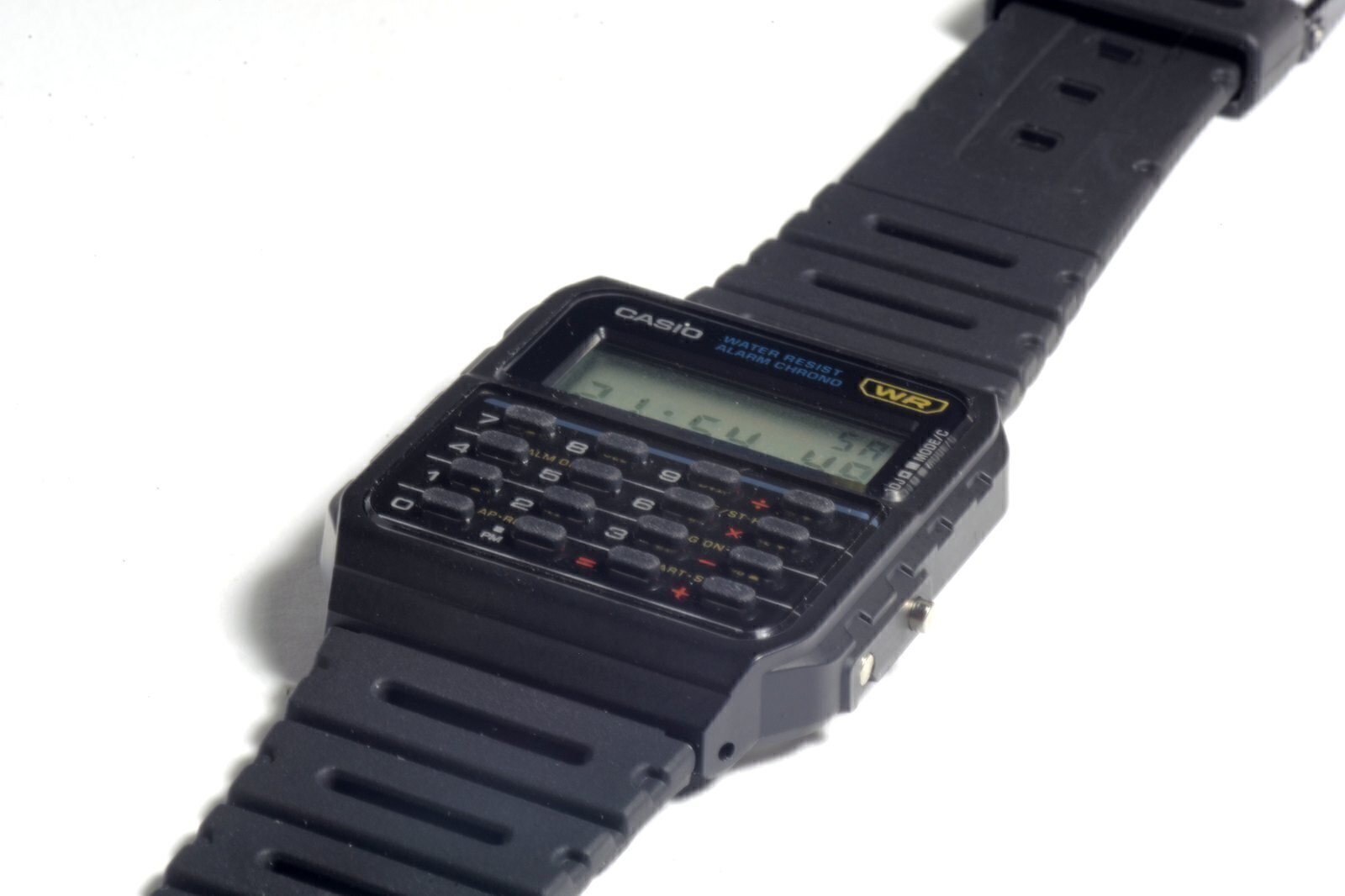
Photo: Morn, Wikimedia Commons · CC BY-SA 4.0
Dates for the Pulsar (1975) and the HP-01 (1977) are well documented. We have deliberately not attached specific years to Casio’s first calculator watches, because Casio does not publish them and secondary sources disagree. Where the record is unclear, this page says so rather than picking a date. Corrections policy
Frequently asked questions
Who invented the calculator watch?
The first commercially sold calculator wristwatch was the Pulsar Time Computer Calculator, launched in 1975 by Pulsar, then a division of the Hamilton Watch Company. Pulsar is therefore credited with the first product rather than with the underlying concept, which several companies were developing at the same time.
When did Casio start making calculator watches?
Casio was producing calculator watches by the early 1980s, in the LCD era that made them affordable. We do not state a specific first model year, because Casio does not publish one for these references and secondary sources disagree.
Why did calculator watches stop being popular?
They did not disappear so much as stop being novel. Mobile phones took over the job of on-the-go calculation, and the multi-function digital watch segment collapsed. The calculator watch survived in a small, steady niche because Casio kept building it.
What was the first calculator watch with an LCD display?
We do not make a specific claim about the first LCD calculator watch, because the record from that period is not reliable enough to name one model with confidence. What is clear is that the shift from LED to LCD in the late 1970s is what made the format affordable.
This article is editorial. Where a figure is given, it comes from the manufacturer’s published documentation and is dated on the page; where we are expressing a judgement, we say so. Something wrong? Tell us.