
Guide · 7 min read
Watch Value Estimator
If you searched for a way to estimate what a watch is worth, you have found the page that explains how that works — and then declines to invent a number for you. That is…
If you searched for a way to estimate what a watch is worth, you have found the page that explains how that works — and then declines to invent a number for you. That is deliberate, and the rest of this page is the explanation. It sets out what actually moves a watch's value, gives you a structured worksheet to organise what you know, and points you at the routes that produce a figure someone will stand behind.
What "watch estimate" usually means
The phrase covers three different jobs, and they are not interchangeable:
- Identification. "What is this watch?" Answered from the case back, the dial, the movement or the reference. Without this, nothing else is possible.
- Valuation. "What is it worth?" Requires comparables, condition assessment and a defined purpose — because the answer for insurance differs from the answer for a quick sale.
- An offer. "What will you give me for it?" That is a price, and it is set by a buyer with their own margin in mind. It is not a valuation, even when it arrives described as one.
Most online tools that promise a "watch estimate" from a photograph are doing the first job and estimating the second from a database they will not show you. At least one commercial service states plainly that its figure is not calculated from verified completed sales. That is honest of them, and it is why their output is labelled an indicative range rather than an appraisal.
The five things that decide what a watch is worth
1. Identity: brand, model and exact reference
This is the whole game. Two watches from the same maker, same era, same look, can differ in value by multiples if one is a scarce reference and the other is the volume model. The reference is stamped on the case back, usually between the lugs, and for digital watches the module or calibre number is often on the case back too. Photograph both in daylight before you search for anything.
2. Condition
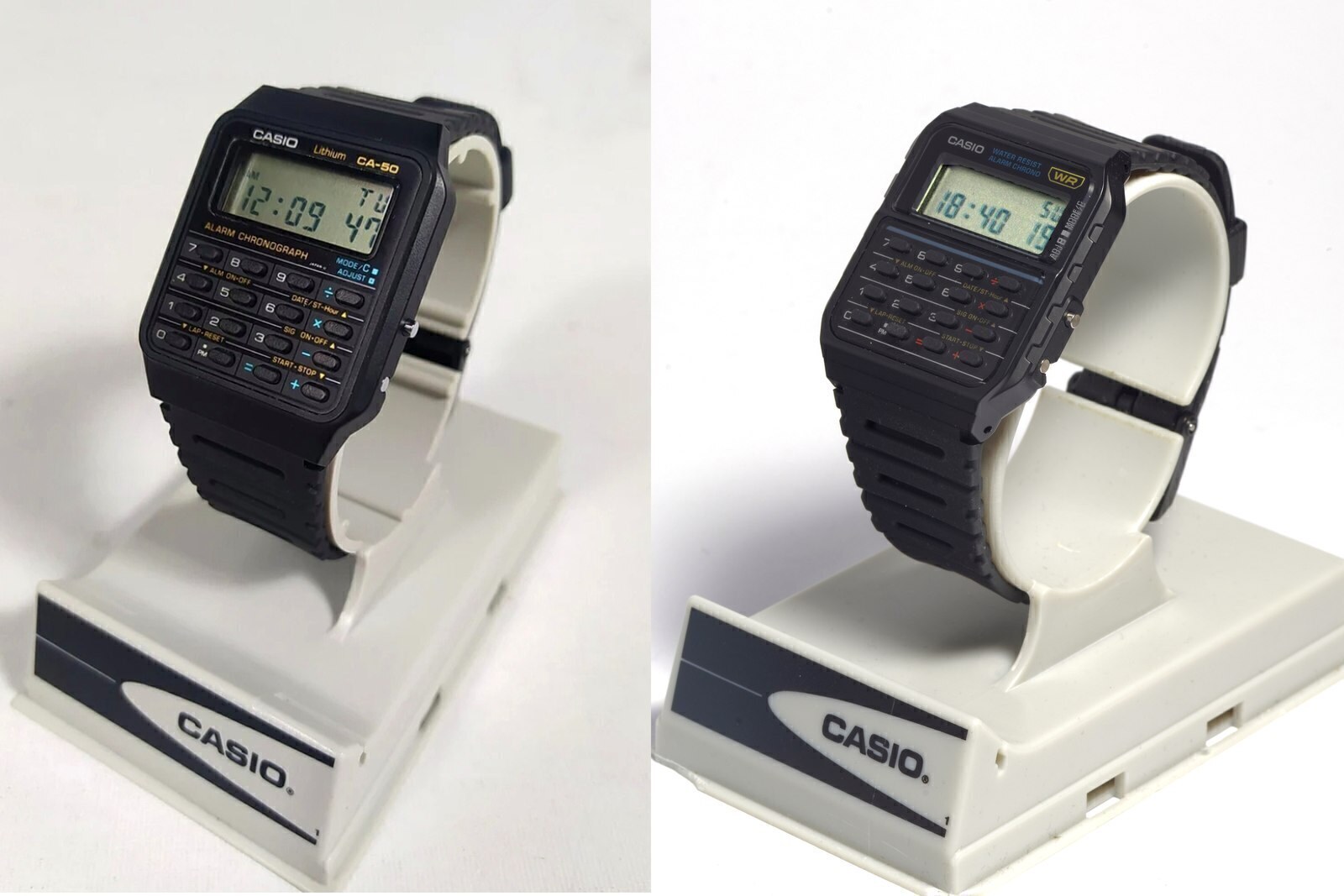
Condition is judged in layers: does it run, does it keep time, how does the case look, is the crystal original, has the plating worn through, does the bracelet have stretch. For a plated resin case — the construction used on several Casio calculator references — plating wear at the corners is normal and expected, and buyers price it in rather than rejecting the watch for it.
3. Originality
Originality means the case, dial, hands, crystal, crown and bracelet are the ones it left the factory with. A replaced crystal or a resealed case back is routine maintenance and roughly neutral. A refinished case, a reprinted dial or an aftermarket bracelet is not, and can halve a collector's interest. Digital watches are usually less sensitive here than mechanical ones, but originality still counts.
4. Completeness
Box, papers, original bracelet, spare links, hang tag, manual, and the purchase receipt if it exists. A "full set" sells faster and for more than the same watch alone. Keep whatever came with the watch, even the packaging — it is the cheapest value you will ever add to it.
5. Demand, which is not the same as rarity
A rare watch nobody is looking for is a cheap watch. A common watch with a film association, a cultural moment or a strong collector following can outperform genuinely scarce pieces. Demand moves with fashion and with events, which is why any valuation has a date attached to it and goes stale.
Why this site will not produce a number
A defensible figure needs four things: a comparables dataset at reference level, completed-sale prices rather than asking prices, a condition adjustment, and a currency and date. We have none of them at the standard required. This is a publication about calculator watches, not a marketplace, and it has no access to a transaction feed.
There is a second reason. A calculator-watch catalogue and a general watch valuation engine are not the same kind of authority. A page that confidently priced an inherited Omega would be claiming expertise we do not have, in service of a keyword. The brief behind this site says not to force a keyword into a shape it does not fit, so the page you are reading does the honest version of the job instead.
What drives a watch's price
Value and price are different questions, and this page is asked both. Value is what a particular watch is worth today. Price is why watches cost what they do in the first place, and understanding it is what stops a shopper paying luxury money for an ordinary watch.
Six things move a price, roughly in order of how much:
- Brand, which is largely a price multiplier rather than a cost. Two watches with similar specifications can sit at opposite ends of the market because one name carries history, distribution and status. This is not a trick: brand is a real thing buyers pay for. It does mean that a specification comparison across brands will mislead you about price.
- Movement. The largest structural difference is quartz versus mechanical. Within mechanical, hand-finished and elaborately decorated movements cost substantially more than industrially finished ones, and a well-known calibre costs more than an equivalent nobody has heard of.
- Materials. Steel is the baseline. Titanium, ceramic, gold and platinum move the price in steps, and the step is often bigger than the difference in function justifies. A sapphire crystal instead of mineral is one of the few material upgrades that pays for itself in use.
- Complications. Every added function is added parts, added assembly and added failure points. A chronograph costs more than a three-hand version of the same watch; a calendar, a repeater or a tourbillon costs considerably more than either.
- Finishing and construction. Applied indices rather than printed ones, a solid rather than folded bracelet, a screw-down case back rather than a press fit, and the tolerances throughout. None of it shows in a specification table, which is exactly why it is where cheap watches economise.
- Distribution. A watch sold direct costs less than the same watch sold through a dealer network with a shop on a high street, and both cost less than a limited edition sold at a premium for being limited. This is the least discussed factor and one of the largest.
Two further variables apply at the moment of purchase. New versus pre-owned is not simply a discount: on some references pre-owned is more expensive than list because the list price is theoretical and the waiting list is real. And channel matters — an authorised dealer, a grey-market seller, a certified pre-owned programme and a private sale each have a different price and a different level of recourse if something is wrong.
The practical consequence is that a watch's price is not a measurement of its quality. It is a measurement of what a market will bear for that combination of name, movement, materials and availability, and the ratio between price and usefulness varies enormously across the range. That is why this site quotes no prices at all: a figure would be wrong somewhere, dated everywhere, and impossible for us to stand behind.
The worksheet
Below is a structured self-assessment. It asks the seven questions a valuer asks, records your answers, and tells you how well documented the watch is — which is the variable you can actually change. It produces no price and stores nothing. Take the summary to a dealer or appraiser, or use it to organise your own photographs before you list the watch.
How to research a value yourself, properly
- Get the reference. Case back, between the lugs, plus any module or calibre number.
- Search sold, not asking. Filter marketplace searches to completed and sold listings. Asking prices tell you what sellers hope for; sold prices tell you what buyers paid.
- Match the variant. Dial colour, bracelet type and market suffix change value. A "steel bracelet version" and a "resin strap version" of the same reference are different watches to a buyer.
- Adjust for condition. Take the middle of the range for good examples and discount for the faults yours actually has, rather than averaging everything together.
- Check what a dealer is asking. For current models, a dealer's asking price minus their margin is roughly what they will pay. That margin is not a small number.
- Date your answer. Write down the date you did the research. Vintage prices move, and a figure without a date is not information.
When to pay for a professional appraisal
Commission a written appraisal when someone else needs the number: an insurer, an executor, a tax authority, or a buyer in a dispute. A formal appraisal describes the item, states the basis of value, and is signed by someone with professional indemnity behind it. It should not be confused with a dealer's verbal opinion, which is free because it is part of a purchase conversation.
For an inherited or long-stored watch of modest value, paying for a formal appraisal is often not worth it. Identifying the reference, photographing it properly and getting a dealer's informal view will usually tell you whether it is worth pursuing further, at no cost.
How this applies to calculator watches
The same five factors govern the value of the watches this site covers, with different emphasis. Reference-level scarcity varies wildly across Casio's calculator line, condition is dominated by plating wear and crystal scratches, and completeness matters less than for a luxury watch — most were bought as tools and used as tools. Demand is unusually event-driven: a film association or a public appearance can move an otherwise quiet reference, and the effect fades.
If you are valuing a specific model, start with the model page in our calculator watch guide, which records verified specifications and flags what has not been verified. The manuals hub helps if you are trying to establish identity from a module number, and the size calculator is the relevant tool if you are buying rather than selling.
Structured worksheet
Watch valuation worksheet
This worksheet organises what you know about a watch into the factors a valuer examines. It produces no price figure — we have no completed-sales data to base one on, and inventing a number would be worse than saying so.
1. I know the exact reference number
Stamped on the case back, and the single most important input. Without it, nobody can value the watch — including an appraiser.
2. It runs and keeps reasonable time
A non-running watch is a repair estimate, not a valuation. Buyers price in the service.
3. It is original and unmodified
Original case, dial, hands, bracelet and module. Replaced parts, refinished cases and non-original crystals all reduce value.
4. Cosmetic condition
Scratches, plating wear, faded printing and crystal crazing. Photograph it in daylight before you judge.
5. Box and papers
Original box, manual, warranty card or hang tag. For collector-grade pieces this can change the price materially.
6. Documented history
Receipt, service records, or a known owner. Undocumented provenance is the norm and is not a red flag on its own.
7. The model is uncommon
Scarcity only lifts a price when people are actually looking for the model. A rare watch nobody collects is still a cheap watch.
Answer all 7 questions to see a documentation summary.
Your answers stay in this browser tab. Nothing is submitted, stored or sent anywhere.
Frequently asked questions
Why does this page not give me a price?
Because we do not have the data to produce one honestly. A credible figure needs a reference-level comparables database of completed sales, adjusted for condition and completeness. This site has no such database and no appraiser on staff. A number invented here would look authoritative and be useless, and would probably be wrong in whichever direction cost you money.
Where can I get a real watch valuation?
Three routes, in ascending order of cost. Market research: search sold listings for your exact reference. Dealer opinion: most established watch dealers will give an informal view for free, and will make an offer. Formal appraisal: a qualified appraiser produces a written valuation suitable for insurance, probate or a dispute, for a fee. For insurance work, ask the insurer what documentation they accept before commissioning anything.
What is the difference between value and price?
Value is a judgement about what a watch is worth; price is what someone actually paid. Asking prices on marketplace listings are neither — they are opening offers, and the gap between an asking price and a completed sale can be large, especially for vintage watches. Only completed sales are evidence, and even those need adjusting for condition.
Does the original box and paperwork really matter?
It matters more for collector-grade pieces than for everyday ones. A full set — box, papers, original bracelet, hang tag — is easier to sell and usually commands more than the same watch without them. For a common quartz calculator watch the effect is modest. For a scarce model in demand it can be a significant proportion of the figure.
Is a working watch worth more than one that needs repair?
Yes, and the gap is usually wider than owners expect, because the buyer has to absorb both the repair cost and the risk that the fault is worse than described. A non-running watch is priced as a project, not as a watch.
This article is editorial. Where a figure is given, it comes from the manufacturer’s published documentation and is dated on the page; where we are expressing a judgement, we say so. Something wrong? Tell us.