
Comparison tool · 8 min read
Compare Calculator Watches
Most calculator watches compute identically. What separates them is physical: how big the case is, how much it weighs, whether there is a backlight, how long the battery…
Specifications last reviewed
Selected models (3/3)
Scroll horizontally on a narrow screen.
| Specification | |||
|---|---|---|---|
| Brand | Casio | Not verified | Casio |
| Price (verified) | Not verified | $35.50 USDAmazon · checked 19 Nov 2026 | Not verified |
| Calculator functions | Four arithmetic operations with constant calculation; percentage; square root; sign change | Four arithmetic operations (+, −, ×, ÷) with constant calculation; percentage key; square-root key; sign change (±); three-key memory on some regional variants (see note) | Four arithmetic operations with constant calculation; sign change (±); memory keys on the keypad |
| Digit capacity | 8 digits | 8 digits | 8 digits |
| Display | Digital LCD (7-segment) | Digital LCD (7-segment, fixed segments) | Digital LCD (7-segment) |
| Case dimensions | 43.2 × 34.4 × 8.2 mm | 43.2 × 34.4 × 8.2 mm | 43.2 × 34.4 × 8.2 mm |
| Weight | 25 g | 25 g | 53 g |
| Strap / band | Resin | Resin | Stainless steel bracelet, adjustable clasp, 150–205 mm band size |
| Case material | Resin | Resin | Resin with chrome plating |
| Glass | Resin glass | Resin glass | Resin glass |
| Battery | CR2016 | CR2016 | CR2016 |
| Battery life | Approx. 5 years | Approx. 5 years | Approx. 5 years |
| Water resistance | Water Resistant (no depth rating published by Casio) | Water Resistant (no depth rating published by Casio; not for swimming) | Water Resistant (no depth rating published by Casio; not for swimming) |
| Other features | Dual time; 1/100-second stopwatch; daily alarm; hourly time signal; full auto-calendar to 2099; 12/24-hour format; button-operation tone on/off; accuracy ±15 seconds per month | Dual time; 1/100-second stopwatch with elapsed, split and 1st–2nd place times; daily alarm; hourly time signal; full auto-calendar to 2099; 12/24-hour format; button-operation tone on/off; accuracy ±15 seconds per month | Dual time; 1/100-second stopwatch; daily alarm; hourly time signal; full auto-calendar to 2099; 12/24-hour format; button-operation tone on/off; accuracy ±30 seconds per month |
| Release information | The CA-53WF references are current Casio catalogue items. Casio does not publish a public key explaining its suffix codes, so we describe only what the specification sheets confirm | Not verified | Casio describes the calculator model as “a perennial favourite since its 1980s debut” and presents the CA-500WE as a metallic reworking of it. The current CA-500WE-1A is a live cat |
“Not verified” means the manufacturer does not publish that value for this reference, or we have not yet confirmed it against their documentation. We never estimate a missing specification. Prices are shown in the retailer’s own currency with the date checked and are not converted.
Most calculator watches compute identically. What separates them is physical: how big the case is, how much it weighs, whether there is a backlight, how long the battery lasts and whether the band can be replaced. The tool below compares any three models on exactly those points, using only specifications published by the manufacturer.
Where a manufacturer does not publish a value, the table says Not verified. We do not fill gaps with retailer claims or estimates, because a comparison table is only useful if every cell means the same thing.
The differences that decide it
Case size and thickness
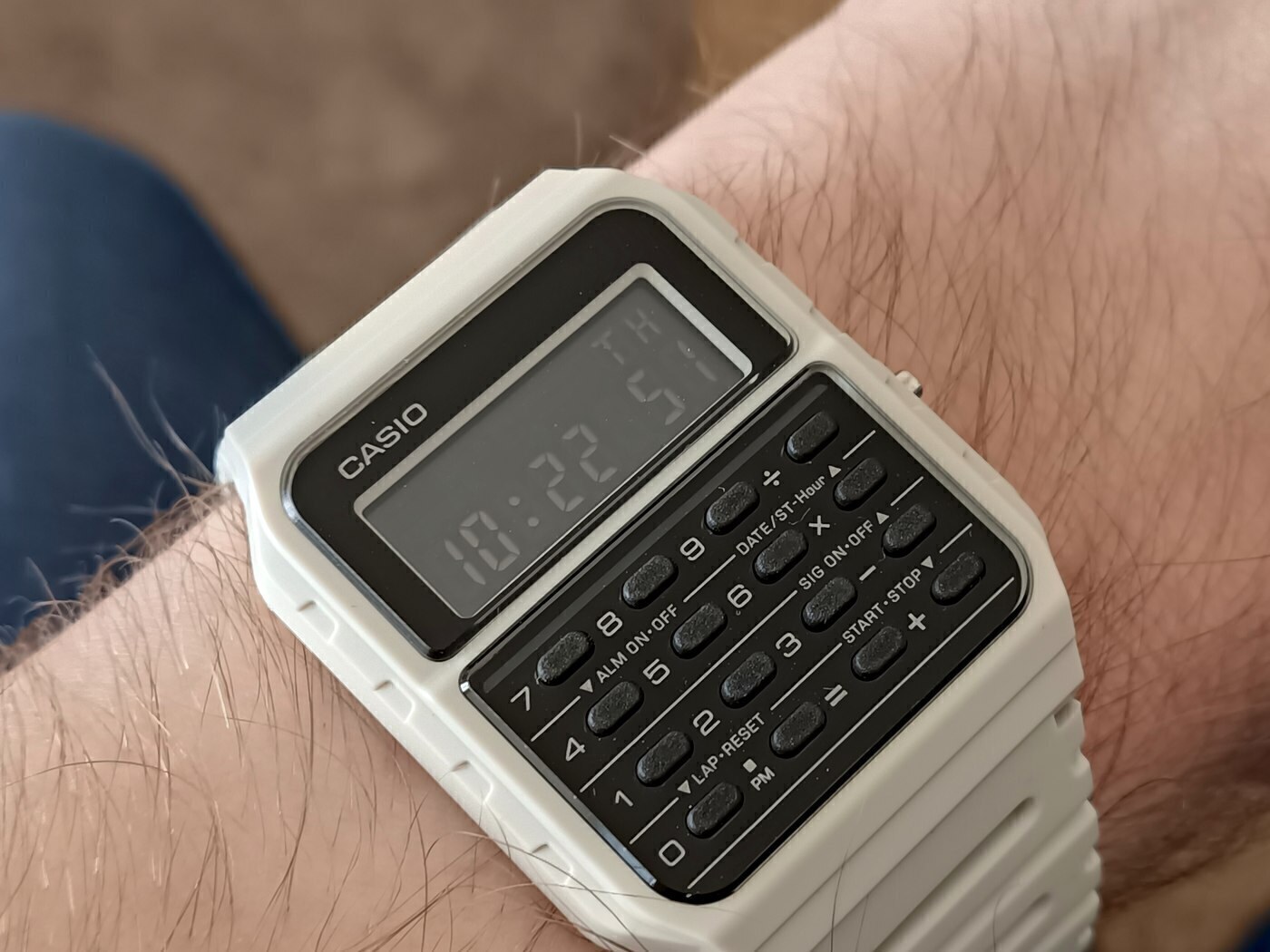
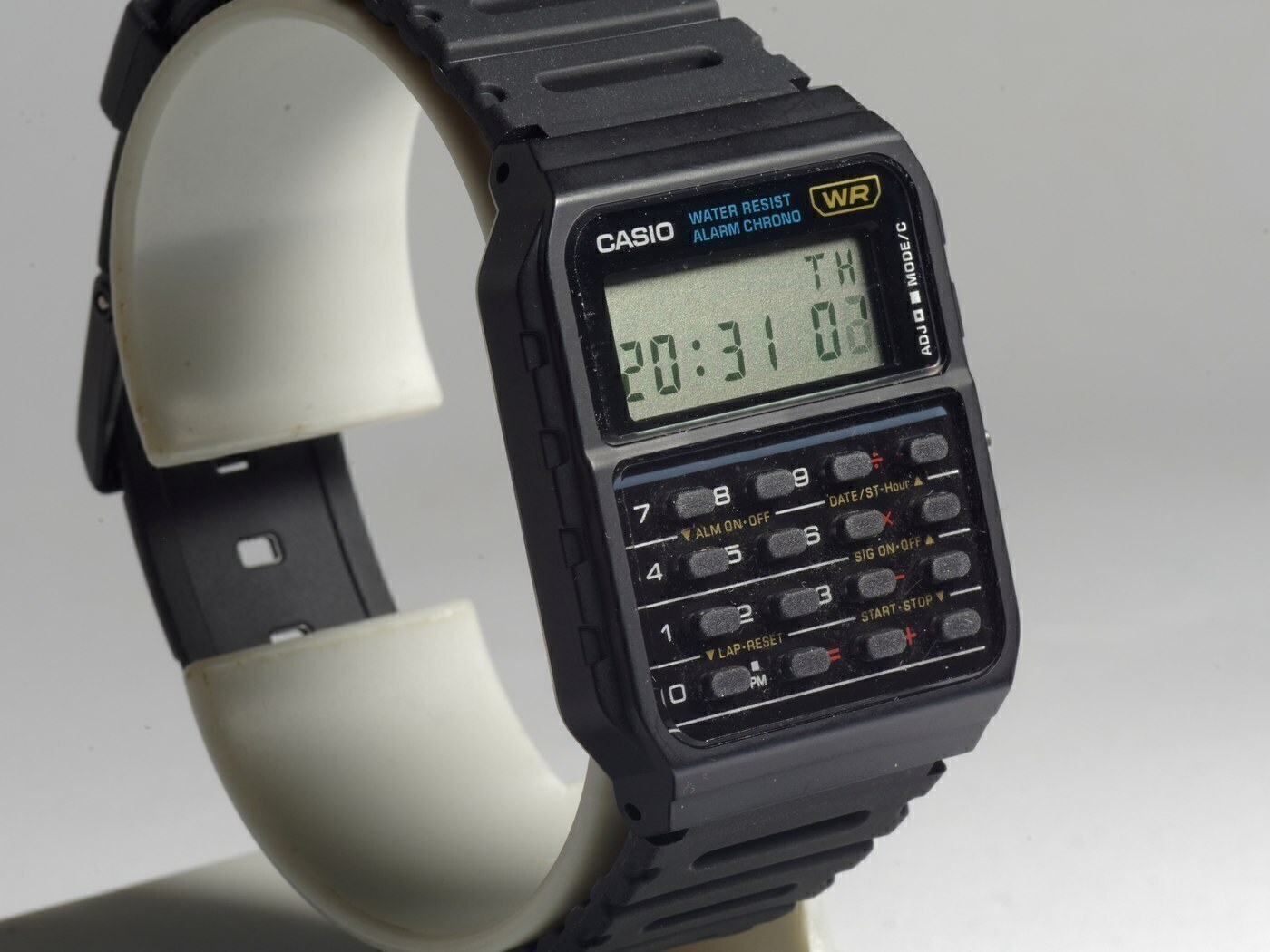
The four current models range from 43.2 × 34.4 × 8.2 mm (CA-53W and CA-500WE) to 50.4 × 37.4 × 12.0 mm (DBC-32). Thickness is the most underrated number: 8.2 mm slips under a cuff, 12.0 mm does not. Width decides whether the case overhangs your wrist.
Weight
25 g for the CA-53W, 53 g for the CA-500WE in the same footprint. The difference is entirely materials — chrome plating and a steel bracelet — and it changes how the watch feels more than any other single specification.
Backlight
Binary and decisive. The CA-series models have none; the Data Bank models have an amber LED with an auto light switch. If you want to calculate in the evening, this is the specification that matters.
Battery
CR2016 at approximately five years for the CA family; CR2025 at approximately ten years for the Data Bank family. Both are standard, inexpensive cells.
Water resistance
None of the current models publishes a depth rating. The CA-series references and the DBC-32 are listed as water resistant; Casio publishes no water-resistance rating for the DBC-611. Comparing them on this row is really a comparison of how much ambiguity you are prepared to accept.
How to use the tool
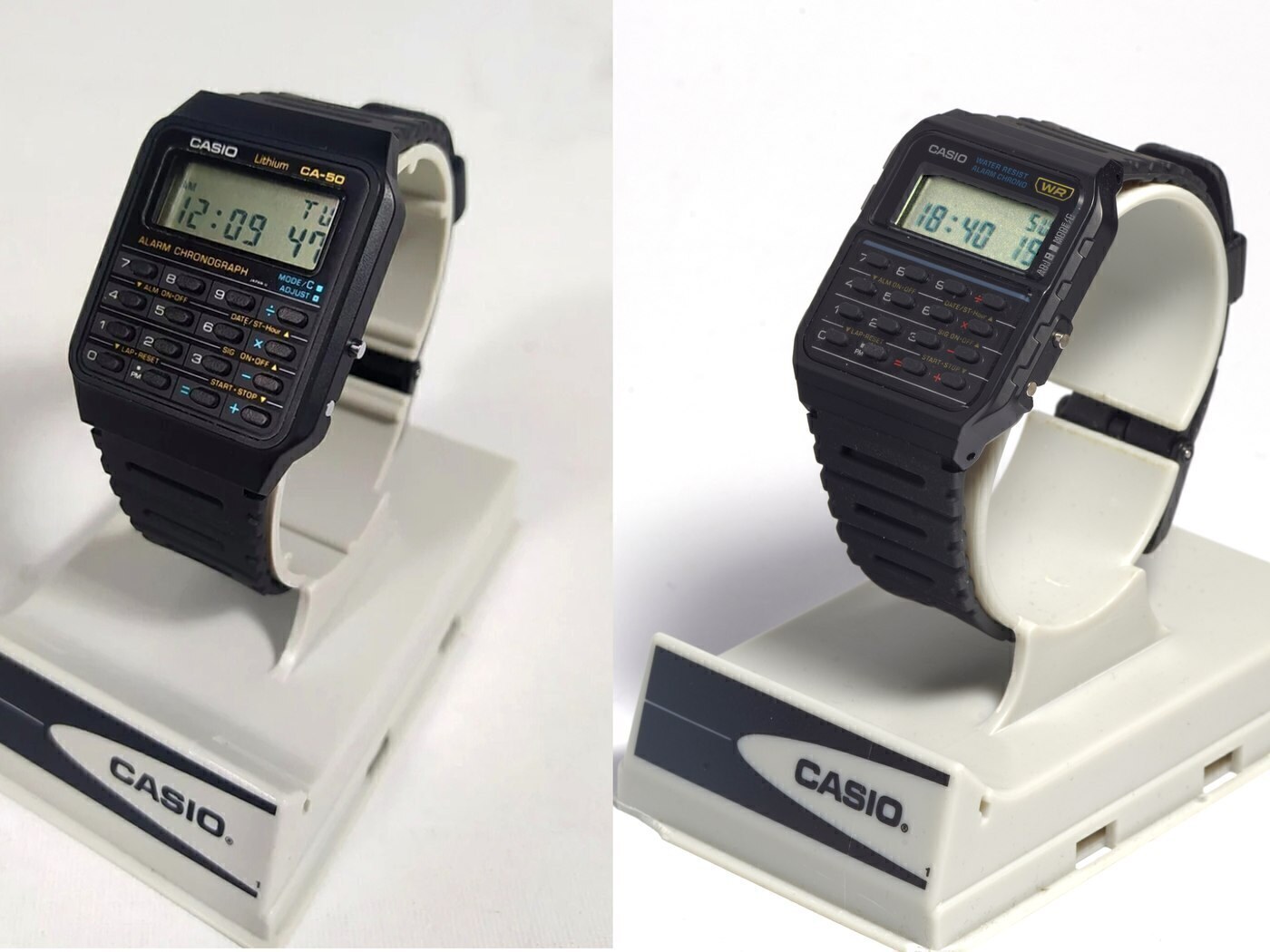
Search for a model, add it to a comparison slot, and repeat for up to three watches. Each column links through to the full model page, where you will find the specification provenance, the editorial assessment and any verified retailer offers. Slots can be removed individually, and the comparison is entirely client-side — nothing about what you compare is sent anywhere.
A note on what is not in the table
We do not include a star rating, a “value score” or a “best for” label generated from price. Those columns look authoritative and are almost always arbitrary. The judgement we do make — which model suits which job — is stated in prose on the best calculator watches page, where we can show our reasoning and you can disagree with it.
Frequently asked questions
Which calculator watch is the smallest?
Of the current models, the Casio CA-53W and CA-500WE are the smallest at 43.2 × 34.4 × 8.2 mm. The CA-53W is also the lightest at 25 g.
Do all calculator watches have the same calculator?
Effectively, within the current Casio line: eight digits, four arithmetic operations with constant calculation. The Data Bank models add a fixed-rate currency converter. Display size and keypad spacing differ, which affects how easy the calculator is to use, but not what it can compute.
Can I compare a discontinued model?
Only models with verified specifications appear in the tool. Where a vintage model has been documented in our database it will appear; otherwise it is excluded rather than compared on incomplete data.